The Batch That Passed Every Obvious Test
A wine producer releases a batch after checking alcohol content, acidity, microbial load, and visual clarity.
Hours later, the first complaints arrive.
The wine smells musty. The defect is not dramatic under a microscope. It is not visible in a bottle. The contaminant may exist at concentrations measured in parts per trillion, yet the human nose can detect the result.
This is the paradox of chlorophenol contamination: the quantity is almost invisible, but the consequence is not.
Chlorophenols can enter food and beverages through treated wood, fungicide residues, packaging components, processing environments, or contaminated rinse water. Fungi such as Aspergillus and Penicillium can then methylate chlorophenols into chloroanisoles, volatile compounds associated with the familiar “cork taint.”
At these concentrations, quality control is no longer simply a matter of measuring what is present. It is a matter of deciding quickly whether production should continue.
Why Trace Contamination Creates a Systems Problem
A contaminant at the parts-per-trillion level creates three connected problems.
The analytical problem
The laboratory must detect a signal close to the lower boundary of measurement. Food and beverage matrices make this harder because they contain alcohols, polyphenols, sugars, extraction solvents, and other compounds that can interfere with the assay.
The operational problem
A production line cannot wait several days for every incoming cork, paperboard component, processing aid, or rinse-water sample to receive a full instrumental analysis.
Every delayed result can hold inventory, slow release decisions, or allow a contaminated material to move further into the process.
The economic problem
Testing every routine sample by GC/MS is technically powerful but operationally expensive. It requires capital equipment, maintenance, trained analysts, and considerable time per batch.
The question is therefore not whether GC/MS can detect chlorophenols. It can.
The better question is:
Which samples require definitive identification, and which samples only require a rapid, defensible screening decision?
That distinction changes the entire testing workflow.
Immunoassay Converts Trace Chemistry into a Practical Decision
Immunoassay technology addresses this problem by using molecular recognition.
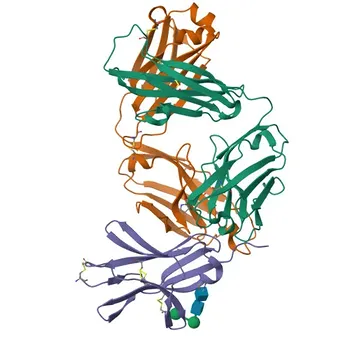
An antibody is designed to bind a target compound, or a related chemical group, through specific non-covalent interactions. In chlorophenol testing, the usual format is a competitive ELISA.
The sample analyte competes with a labeled analogue for a limited number of antibody-binding sites. After the unbound material is washed away, an enzyme substrate produces a measurable color signal.
The relationship is intentionally counterintuitive:
- More chlorophenol in the sample means less labeled conjugate remains bound.
- Less bound conjugate produces a weaker color signal.
- A lower optical signal therefore indicates a higher contaminant concentration.
This turns an invisible chemical event into a plate-reader measurement that a routine quality-control laboratory can interpret.
The technology does not make the chemistry less demanding. It places the complexity inside the assay design, where it can be controlled through antibody selection, conjugate engineering, buffer optimization, and validation.
From Nanograms per Liter to a One-Hour Workflow
A 96-well plate can accommodate standards, controls, and dozens of samples in the same run.
Depending on the assay format and sample preparation, the workflow can often be completed in less than an hour:
- Prepare or dilute the sample.
- Add the sample and labeled chlorophenol analogue.
- Allow competitive binding to occur.
- Wash away unbound components.
- Add the chromogenic substrate.
- Read the optical signal.
- Compare the result with the calibration curve and decision threshold.
The value is not merely speed.
Fast screening changes when a laboratory can act. A result received during production can prevent a contaminated lot from becoming a finished-goods problem. A result received days later may only explain why the problem happened.
The Raw Materials Determine the Detection Floor
An immunoassay is often described as a platform. In practice, its performance is determined by the quality and compatibility of its raw materials.
For trace-level chlorophenol detection, three component groups are especially important.
High-affinity antibodies
The antibody establishes how efficiently the assay can capture and distinguish the target.
A high-affinity antibody forms a stable antigen-antibody complex. Its affinity, often represented by the dissociation constant, or Kd, directly influences the concentration range in which the assay remains useful.
For chlorophenol applications, antibody development must answer two questions:
- How low can the assay detect the target?
- Which related compounds will the antibody recognize?
A monoclonal antibody may provide strong consistency and defined specificity. A polyclonal antibody may offer broader recognition across related chlorophenols or chloroanisoles.
Neither choice is automatically superior. The correct choice depends on the decision being made.
If the goal is broad screening of packaging materials, class recognition may be valuable. If the goal is to distinguish a specific regulated congener, excessive cross-reactivity may become a liability.
Enzyme conjugates and substrates
The labeled analogue must compete effectively with free chlorophenol in the sample.
If the conjugate binds too strongly, the assay may become less responsive within the desired concentration range. If it binds too weakly, the signal may become unstable or difficult to interpret.
The enzyme system must also create enough signal amplification to distinguish trace differences without increasing background. Horseradish peroxidase conjugates paired with sensitive chromogenic substrates are commonly used because they can translate small binding differences into measurable optical changes.
Buffers and blockers
A strong antibody cannot compensate for poor matrix management.
Buffers control pH, ionic strength, solvent compatibility, and nonspecific interactions. Blocking agents reduce unwanted binding to the plate surface or assay components.
These materials are not secondary ingredients. They help ensure that the measured signal reflects chlorophenol concentration rather than the chemical personality of the sample.
A red wine extract, a rinse water sample, and a paperboard extraction will not behave identically. Robust buffers and blockers make the assay more resilient across these changing environments.
Choosing the Right Specificity
Cross-reactivity is often presented as a technical defect. That is too simple.
In a screening assay, recognition of structurally related compounds can be useful. A broad-specificity antibody may provide an early warning that a material contains a family of chlorophenol-related contaminants.
But a broad signal may represent several compounds rather than one precisely identified analyte. That matters when toxicological profiles, regulatory limits, or corrective actions differ between congeners.
Assay specificity should therefore be matched to the risk model.
| Testing objective | Preferred assay characteristic | Main value |
|---|---|---|
| Incoming inspection of corks and paperboard | Broad recognition of relevant chlorophenols and chloroanisoles | Rapid material release or rejection |
| Monitoring processing water and rinse waters | High sensitivity with a simple workflow | Early warning before contamination spreads |
| Investigation of a sensory defect | Sensitive triage with follow-up confirmation | Faster narrowing of the source |
| Regulatory confirmation | High specificity or a complementary chromatographic method | Defensible identification and quantification |
The design decision is psychological as much as analytical.
A laboratory does not need every test to answer every question. It needs each test to answer its assigned question reliably.
When Immunoassay Is the Right First Move
Routine testing often fails because laboratories treat every sample as if it were an investigation.
That approach creates a queue.
A better workflow separates screening from confirmation.
Screen broadly
Use competitive ELISA, lateral-flow formats, or antibody-based biosensors to test large numbers of samples quickly.
Negative results can be cleared without consuming instrument capacity. Suspect results can be isolated for further review.
Confirm selectively
Use GC/MS or another chromatographic method when a result requires compound-level identification, regulatory evidence, or forensic investigation.
This two-tier approach preserves the strengths of both technologies:
- Immunoassay provides speed, scale, and lower routine cost.
- GC/MS provides structural confirmation and detailed quantification.
The result is not a compromise. It is a better allocation of analytical attention.
Where Biosensors Extend the Workflow
The same high-affinity antibodies used in ELISA can be integrated into biosensor platforms.
Surface plasmon resonance systems can monitor binding interactions in real time and provide kinetic information. Electrochemical sensors can convert antibody-analyte interactions into electrical signals suitable for compact or field-oriented systems.
These formats may support:
- On-site testing near receiving docks
- Rapid checks of processing water
- Near-line monitoring
- Reduced dependence on centralized laboratory schedules
- Future inline contamination alerts
Their usefulness depends on more than antibody affinity. Surface chemistry, immobilization stability, regeneration, nonspecific binding, and sample compatibility all affect performance.
The engineering challenge is to preserve molecular recognition while making the measurement practical in the environment where the decision occurs.
Sample Preparation Still Matters
Immunoassay does not eliminate the need to understand the sample.
Some matrices may require dilution, filtration, extraction, pH adjustment, or solvent control. These steps reduce matrix effects, but they also create opportunities for recovery loss or operator variability.
A useful validation program should examine:
- Recovery across representative food and beverage matrices
- Dilution linearity
- Precision between operators and days
- Stability of standards and conjugates
- Interference from alcohols, polyphenols, and extraction solvents
- Cross-reactivity with relevant chlorophenol and chloroanisole compounds
- Agreement with a reference chromatographic method
- Performance around the operational decision threshold
The purpose is not to produce a perfect number in every situation.
The purpose is to know when the result is dependable enough to release a material, stop a process, or trigger confirmation.
The Practical Comparison
| Feature | Competitive Immunoassay | GC/MS |
|---|---|---|
| Detection capability | Can reach ng/L, sub-ppb screening levels with optimized reagents | Strong sub-ppb identification and quantification |
| Typical role | High-volume routine screening | Confirmatory analysis and investigations |
| Throughput | Dozens of samples per 96-well plate | More limited batch throughput |
| Turnaround | Often less than one hour | Commonly hours to days, depending on workflow |
| Equipment | Plate reader and standard laboratory equipment | High capital cost, maintenance, and specialist infrastructure |
| Operator requirement | Routine laboratory technician training | Highly trained analytical specialist |
| Main limitation | Cross-reactivity and matrix effects | Cost, time, and operational complexity |
The comparison is not about replacing one technology with another.
It is about building a testing system in which the expensive, slow method is reserved for the samples that truly need it.
A Supply Chain Decision, Not Only a Laboratory Decision
For diagnostic manufacturers, testing laboratories, and research institutes, assay performance depends on the continuity of the materials behind it.
An antibody that performs well in development but varies between production lots can undermine an otherwise sound workflow. A conjugate with inconsistent labeling can shift calibration behavior. A buffer that works in one matrix but fails in another can create unexplained results.
This is why raw-material selection should include more than a product specification sheet.
The supplier must be able to support:
- Consistent access to critical antibodies and conjugates
- Technical documentation and lot information
- Matrix-specific assay development
- Troubleshooting during optimization
- Scale-up from feasibility work to routine production
- Integration with ELISA, biosensor, or other diagnostic formats
- Technical consulting across development and implementation
CamelBio supports diagnostic manufacturers, laboratories, and research institutes with one-stop access to IVD raw materials, technical services, and consulting. Its support can extend from early assay concept and component selection through optimization, validation, and clinical or routine laboratory implementation.
That continuity matters because trace-level detection is rarely solved by one reagent alone. It is solved by making the entire system work together.
The Engineering Logic of Trace-Level Detection
The most effective chlorophenol testing strategy follows a simple logic:
- Define the decision threshold.
- Identify the matrices and contamination routes.
- Select antibody specificity according to the risk being screened.
- Optimize conjugates, substrates, buffers, and blockers as a system.
- Validate recovery and interference in real sample types.
- Screen routine samples rapidly.
- Confirm only the results that require definitive identification.
- Feed confirmed findings back into supplier, process, and packaging controls.
This sequence reduces both analytical waste and decision delay.
It also respects a basic truth about quality systems: the best test is not the one with the most impressive instrument. It is the one that produces the right information at the moment someone can still act on it.
Conclusion: Make the Invisible Manageable
Chlorophenol residues show how a microscopic chemical problem can become a large operational event.
A few parts per trillion can affect aroma, consumer trust, product release, and brand reputation. Yet testing every sample with the most complex available method is not a sustainable answer.
Competitive immunoassays provide a practical first line of defense. With high-affinity antibodies, carefully engineered conjugates, robust buffers, and matrix-aware validation, they can bring trace-level screening into the daily rhythm of a quality laboratory.
The result is a more intelligent division of labor: rapid immunoassay screening for scale, and GC/MS confirmation for the cases that demand molecular certainty.
To build a reliable trace-residue workflow from assay concept to dependable raw-material supply, connect with Contact Our Experts.
Related Products
- Anti-C-Peptide Rabbit Monoclonal Antibody for IF/ICC, IF-P, IHC-P, ELISA - P01308
- Anti-PCIF1 Rabbit Monoclonal Antibody for WB, IHC-P, IP, ELISA - Q9H4Z3
- Cy5 Rabbit mAb - CAS:146368-15-2
- Anti-CHAT Rabbit Polyclonal Antibody for WB, IHC-P, ELISA - P28329
- Anti-CMIP Polyclonal Antibody for WB, IHC-P, ELISA - Q8IY22