The Design Problem Behind “One Test, Many Pesticides”
A food-safety laboratory receives a sample suspected of containing pesticide residues.
The practical question is rarely, “Is compound X present?”
More often, it is:
Does this sample contain any member of a chemical class above a meaningful screening threshold?
That distinction changes the entire immunoassay development strategy.
A single-target antibody is designed to recognize what makes one molecule unique. A generic antibody must recognize what several molecules share. The difference is not primarily in the final ELISA protocol or lateral flow format. It begins with the structure of the hapten used to train the immune system.
The central design task is simple to state but difficult to execute:
Expose the conserved molecular skeleton, while attaching the carrier protein where the target molecules differ.
When this geometry is correct, the immune system is encouraged to recognize a chemical family rather than one isolated residue.
Why Small Pesticides Need a Molecular “Stage”
Most pesticides have molecular weights below 500 Da. They can bind to antibodies, but they are generally too small to trigger a strong immune response by themselves.
They are haptens: antigenic molecules that require a larger immunogenic partner.
Developers therefore covalently link the pesticide-derived hapten to a carrier protein such as:
- Bovine Serum Albumin (BSA) for immunogen or coating conjugates
- Keyhole Limpet Hemocyanin (KLH) for immunization
- Other carrier systems selected according to the assay and conjugation chemistry
The carrier supplies the biological scale. The hapten supplies the chemical information.
This creates a useful division of labor:
| Component | Primary role |
|---|---|
| Hapten | Defines which molecular features the immune system can learn |
| Spacer arm | Controls how the hapten is presented and how accessible it is |
| Carrier protein | Provides immunogenic size and biological context |
| Adjuvant | Supports immune stimulation but cannot replace hapten design |
An adjuvant may strengthen the response. It cannot correct a hapten that presents the wrong epitope.
The Linker Position Determines the Antibody’s View
Imagine placing a large carrier protein next to a small pesticide structure.
The attachment point determines which part of the pesticide remains visible and which part becomes physically or chemically obscured. The antibody response will be shaped by that view.
For broad-spectrum detection, the spacer arm should usually replace a variable functional group. This leaves the conserved core exposed.
The logic can be represented as follows:
- Identify the structural features shared by the pesticide family.
- Identify the side chains or functional groups that vary between analytes.
- Attach the spacer at, or near, the variable region.
- Present the shared skeleton as the dominant accessible epitope.
- Screen resulting antibodies against a panel of related compounds.
The carrier is not merely a support. It is part of the presentation geometry.
A linker attached to the wrong position can teach the immune system to focus on a feature that exists in only one analyte. The resulting antibody may be highly specific, but that specificity becomes a liability when the assay is intended for class-wide screening.
The Core Rule
| Desired antibody profile | Linker placement | Structure presented to the immune system |
|---|---|---|
| Broad-class recognition | Variable functional group site | Conserved molecular core |
| Single-analyte sensitivity | Conserved region | Unique functional groups |
| Controlled multi-residue recognition | Optimized or iterative site | Shared skeleton with selected side chains |
Conformation Matters as Much as Connectivity
Two molecules can have similar two-dimensional structures and still behave differently in an antibody-binding site.
Antibodies recognize three-dimensional chemical surfaces. They respond to:
- Bond angles
- Steric accessibility
- Charge distribution
- Hydrogen-bonding patterns
- Aromatic orientation
- Local flexibility
- The lowest-energy solution-phase conformation
A hapten that is chemically related to a pesticide family but adopts the wrong conformation may generate antibodies that bind only a subset of the intended analytes.
This is why successful hapten engineering goes beyond selecting a reactive functional group. Developers need to ask whether the conjugated hapten remains a credible three-dimensional and electronic mimic of the shared pesticide core.
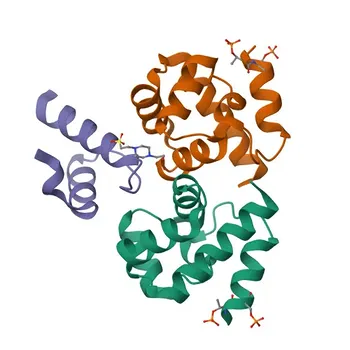
Computational modeling can help compare candidate structures before synthesis. Conformational analysis can reveal whether the spacer forces an unnatural orientation. In more advanced workflows, structural methods such as X-ray crystallography can provide additional insight into how the hapten or antibody-binding site supports recognition.
The objective is not to reproduce every atom of every pesticide. It is to reproduce the features that should remain invariant across the class.
Example: Organophosphate Pesticides
Organophosphate pesticides often share a phosphorothioate or phosphate center surrounded by variable alkyl or aryl groups.
The challenge is to make the antibody recognize the family-level architecture without becoming dependent on one particular substituent.
A broad-spectrum hapten may be designed by attaching the spacer at the phosphorus atom in a way that replaces one variable alkoxy group. This can leave other characteristic groups, such as O,O-diethyl or O,O-dimethyl motifs, accessible to the immune system.
The antibody is then more likely to recognize shared chemical patterns found across compounds such as:
- Parathion
- Chlorpyrifos
- Diazinon
- Related organophosphate residues
The exact cross-reactivity profile will depend on the hapten structure, conjugation chemistry, immunization strategy, and clone selection. The design principle remains consistent: preserve the features that define the class and avoid masking them with the carrier.
Example: Pyrethroid Pesticides
Pyrethroids contain conserved structural elements associated with their cyclopropane carboxylate and phenoxybenzyl frameworks, while other substituents distinguish individual compounds.
If the linker is attached at the position occupied by a variable alcohol or cyano-related group, the resulting hapten may expose the shared acid moiety and aromatic system.
This creates the possibility of antibodies that recognize multiple type-I and type-II pyrethroids in a single screening format.
Such antibodies can support:
- Competitive ELISA
- Lateral flow immunoassays
- Rapid food-safety screening
- Environmental residue monitoring
- High-throughput sample triage before confirmatory analysis
The assay does not need to replace confirmatory chromatography to create value. Its role may be to quickly identify samples that require closer examination.
Broad Recognition Is a Deliberate Trade-Off
A generic antibody is not a compromise caused by poor optimization. It is a different engineering objective.
A highly specific antibody may detect one pesticide at an extremely low concentration while showing little response to related compounds. A generic antibody may produce a higher limit of detection for each individual analyte, but it can detect a broader group with one test.
| Performance priority | Typical antibody behavior | Suitable use |
|---|---|---|
| Maximum single-analyte sensitivity | Narrow specificity and low detection limit | Precise quantification |
| Broad class coverage | More balanced cross-reactivity | High-throughput screening |
| Defined group or hazard index | Controlled response across selected residues | Risk-oriented reporting |
For many screening applications, the relevant question is not the exact concentration of one compound. It is whether the combined or representative residue burden may exceed a regulatory or operational threshold.
In that context, a broad response can be more useful than extreme sensitivity to a single target.
The correct performance target should therefore be defined before hapten synthesis.
Three Common Design Failures
1. Masking the Conserved Core
Attaching the spacer to a structural feature shared by the whole pesticide class can hide the very epitope the antibody needs to recognize.
The immune response may then be redirected toward the linker, the carrier, or a peripheral feature that differs between analytes.
2. Reproducing the Wrong Conformation
A hapten may have the right atoms but the wrong spatial arrangement.
If conjugation locks the molecule into an unnatural geometry, antibodies may bind the synthetic hapten while responding weakly to the native pesticide in solution.
3. Using an Insufficient Spacer
A carrier protein is large and highly crowded compared with a pesticide molecule.
When the spacer is too short, the carrier can sterically shield the hapten. The target epitope becomes difficult for immune cells to access, and the resulting antibodies may show weak or inconsistent binding.
Spacer length must be treated as part of the epitope design, not as an afterthought.
From Hapten Concept to Clone Selection
A strong design still requires disciplined experimental screening.
Developers should evaluate candidate antibodies against a representative analyte panel rather than relying on one nominal target. The panel should include:
- Major members of the intended pesticide class
- Structurally close analogues
- Compounds with different side-chain substitutions
- Potential interferents
- Relevant matrix components where possible
The resulting data should be interpreted as a recognition profile.
For example, a project may define its target profile as:
- 50–100% relative response for priority residues
- Limited response to non-target pesticide classes
- Acceptable matrix tolerance
- Consistent performance in the intended assay format
This is particularly important when the final kit reports a group value, hazard index, or class-equivalent concentration. The antibody does not need identical affinity for every molecule, but the variation must be understood and controlled.
Match the Hapten Strategy to the Commercial Use Case
The intended customer and workflow should influence the design from the beginning.
Broad-Class Screening
Choose this direction when the kit must screen many related residues rapidly.
Priorities include:
- Conserved-core exposure
- Broad and balanced cross-reactivity
- Simple sample preparation
- Compatibility with ELISA or lateral flow formats
- Sufficient sensitivity for screening thresholds
This approach is well suited to food manufacturers, inspection laboratories, and environmental monitoring programs.
Single-Pesticide Quantification
Choose a more selective hapten when the assay is intended to measure one compound precisely.
The linker may be positioned to expose the unique functional groups of that pesticide while masking conserved elements. This can reduce cross-reactivity and improve analyte-specific performance.
Controlled Multi-Residue Detection
Some applications require neither maximum breadth nor absolute specificity.
A developer may need strong responses to a defined group of priority compounds, with limited response to related but irrelevant residues. This requires iterative hapten design, multiple conjugates, and clone screening against a carefully selected panel.
The commercial value lies in turning an analytical requirement into a reproducible kit specification.
A Development Workflow for Generic Antibody Programs
| Stage | Key question | Output |
|---|---|---|
| Chemical mapping | Which structures are conserved and which are variable? | Target-class epitope map |
| Hapten design | Where should the carrier be attached? | Candidate hapten structures |
| Spacer optimization | Is the epitope accessible and correctly oriented? | Linker and conjugation options |
| Carrier selection | Which carrier supports the intended immune response? | Immunogen and coating conjugate plan |
| Immunization | Does the conjugate produce a useful response? | Antisera or hybridoma candidates |
| Panel screening | Do clones recognize the required analyte set? | Cross-reactivity profile |
| Assay integration | Does performance survive the final format and matrix? | Prototype ELISA or LFIA |
| Kit validation | Is the response reliable for the stated use? | Technical and commercial validation package |
The critical transition is from “an antibody binds the hapten” to “the antibody performs predictably against native residues in real samples.”
That is where many promising concepts either become practical tools or stop at the research stage.
Why Specialist Support Can Shorten the Path
Generic antibody development combines organic synthesis, immunochemistry, structural analysis, and assay engineering.
A problem in any one layer can appear later as:
- Poor cross-reactivity
- Unexpected false negatives
- Excessive matrix effects
- Weak signal development
- Unstable conjugates
- An assay that works with purified standards but fails in real samples
A coordinated development partner can help connect these decisions early. This includes hapten synthesis, linker optimization, carrier conjugation, antibody development, screening-panel design, and assay-format adaptation.
For diagnostic manufacturers, laboratories, and research institutes, that coordination can reduce the distance between a chemical concept and a deployable IVD product.
The Broader Lesson
Hapten engineering is a form of information design.
A pesticide molecule contains more structural information than the immune system should necessarily preserve for a class-wide assay. The developer must decide which details remain visible and which are deliberately removed from view.
A generic antibody is created by controlling that reduction.
Expose too little, and the antibody becomes weak. Expose the wrong feature, and it becomes narrowly specific. Expose the conserved core with the right geometry, and one molecular design can support detection across an entire chemical family.
That is the engineering logic behind broad-spectrum immunoassays: not asking the antibody to recognize everything, but teaching it to recognize the right thing.
CamelBio supports diagnostic manufacturers, labs, and research institutes with one-stop access to IVD raw materials, custom technical services, and consulting across the development path from concept to clinic. To discuss hapten design, conjugation, antibody development, or pesticide-residue assay integration, Contact Our Experts.
Related Products
- Fluorescein Isothiocyanate/FITC Rabbit pAb - Anti-FITC
- Anti-NRAS Rabbit Polyclonal Antibody for WB - P01111
- Rabbit anti-FITC/5-FAM/6-FAM mAb - FITC
- Anti-BRCA1 Polyclonal Antibody for WB, IHC-P, IF/ICC, ELISA - P38398
- Anti-Catalase Polyclonal Antibody for WB, IHC-P, IF/ICC, ELISA - P04040