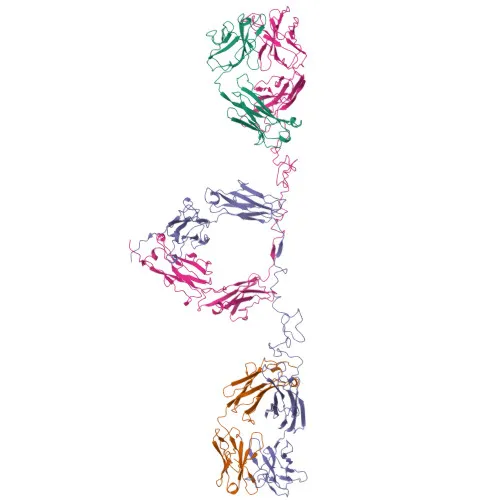
Monoclonal Antibodies
Anti-Human/Monkey IgD Monoclonal Antibody for Flow Cytometry - P01880
Item Number : CM0011036
Price varies based on specs and customizations
- Application
- FC (Flow Cytometry)
- Cross Reactivity
- Human, Cynomolgus
- Protein Weight
- 47kDa

Shipping:
Contact us to get shipping details Enjoy On-time Dispatch Guarantee.
Why Choose Us
Easy ordering process, quality products, and dedicated support for your business success.
Core Product Specifications and Parameters
| Parameter | Value |
|---|---|
| Product Name | Rabbit anti-Human/Monkey IgD mAb |
| Remarks/Alias | IGHD |
| Species | Human |
| GeneID | 3495 |
| Immunogen | Recombinant protein | Recombinant fusion protein containing a sequence corresponding to amino acids 99-384 of human IgD. |
| Source | Rabbit |
| Category | Monoclonal Antibodies |
| Application | FC |
| Cross Reactivity | Human, Cynomolgus |
| SWISS | P01880 |
| Protein Weight | 47kDa |
| Shipping | Ice bag |
Biological Background: IgD Function and Localization
- IgD is the constant region of immunoglobulin delta heavy chain, which can exist as membrane-bound or secreted glycoproteins produced by B lymphocytes.
- Membrane-bound IgD serves as the B-cell receptor (BCR), which upon antigen binding triggers B-cell activation and differentiation via phosphorylation of CD79A and CD79B.
- Secreted immunoglobulins mediate the effector phase of humoral immunity, eliminating bound antigens. Related references: PMID:20176268, PMID:22158414
- The variable domains of immunoglobulins are assembled by V-(D)-J rearrangement and can undergo somatic hypermutations, allowing affinity maturation for a particular antigen. Related references: PMID:17576170, PMID:20176268
- IgD is co-expressed with IgM on the surface of most peripheral B-cells, and they share identical V regions and antigen-binding sites.
- Soluble IgD is present in serum at lower concentrations than IgG, IgA, and IgM but much higher than IgE, and it acts as a potent inducer of cytokines such as TNF, IL1B, IL1RN, IL6, IL10, and LIF from peripheral blood mononuclear cells, primarily monocytes. Related references: PMID:10702483, PMID:11282392, PMID:8774350
- Subcellular localization: IgD is found both secreted and as a transmembrane protein on the cell membrane.
- Keywords: IgD features immunoglobulin domains, disulfide bonds, glycosylation, and transmembrane helices, and is involved in adaptive immunity.
Experimental Guidance and Technical Tips
- This recombinant rabbit monoclonal antibody offers high batch-to-batch consistency and affinity, making it suitable for reproducible flow cytometry assays.
- The conjugate is ready-to-use; avoid freeze-thaw cycles and protect from light.
- For flow cytometry, titrate the antibody to determine the optimal staining concentration in your cellular system; include appropriate isotype controls and Fc receptor blocking.
- Validate antibody performance using B-cell lines or primary peripheral blood mononuclear cells known to express surface IgD.
- Consider permeabilization buffers if also assessing intracellular IgD.
CamelBio: Your One-Stop Sourcing Bridge
- As a dedicated IVD raw-material partner, CamelBio supplies this high-quality anti-IgD antibody to support B-cell research and diagnostic development.
- Complement your projects with our validated antibody pairs, bulk ancillary reagents, and rare target sourcing services—ensuring seamless integration from discovery to assay manufacturing.
- Reach out to explore how CamelBio can accelerate your humoral immunity and immunophenotyping programs.
REQUEST A QUOTE
Our professional team will reply to you within one business day. Please feel free to contact us!
Related Articles
Why Direct Hapten Coupling Changes the Economics of Small-Molecule Biosensors
Compare direct hapten coupling with protein conjugates to improve ligand density, signal quality, antibody efficiency, and chip reusability.
From Molecular Recognition to Reliable Results: Engineering Biosensors for Rapid Safety Testing
How antibodies and enzymes turn invisible molecular events into reliable biosensor signals, and how material quality determines test performance.
When a Surface Becomes a Sensor: Choosing Between QCM, SAW, and Six Classes of Quality Detection
Explore six sensor families, how QCM and SAW convert molecular binding into frequency shifts, and why surface chemistry determines diagnostic reliability.
ROX in Real-Time PCR: The Optical Trade-Off Behind Precision and Multiplexing
Understand how ROX normalization corrects qPCR signal variation, how optics consume channels, and how to choose the right master mix.
The Silent Well: How No Template Controls Protect Molecular Diagnostic Integrity
A practical guide to No Template Controls: how unexpected qPCR signals reveal contamination, reagent impurities, artifacts, and broken workflow controls.
Why Minor Groove Binders Turn Short Hydrolysis Probes into Precision Diagnostic Tools
MGB chemistry improves probe stability, SNP discrimination, signal-to-noise ratio, and low-copy detection in demanding molecular assays.
Why Dioxin Immunoassays Fail in Complex Matrices—and How to Engineer Them for Reliable Screening
Explore how matrix interference, antibody cross-reactivity, and sample preparation limit dioxin immunoassays—and how better materials and workflows improve accuracy.