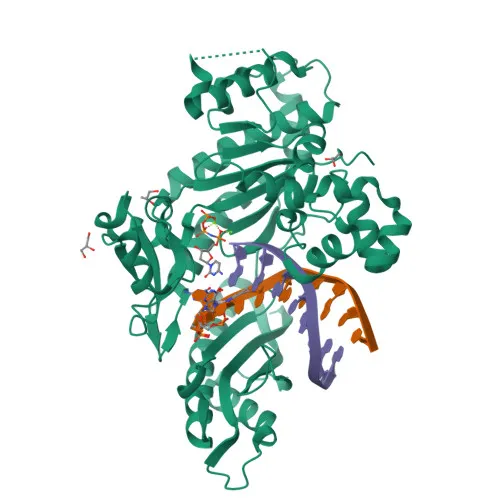
Polyclonal Antibodies
Anti-DNA polymerase eta Polyclonal Antibody for WB - Q9Y253
Item Number : CM0019777
Price varies based on specs and customizations
- Application
- WB, IF/ICC, ELISA
- Cross Reactivity
- Human, Mouse, Rat
- Protein Weight
- 78kDa

Shipping:
Contact us to get shipping details Enjoy On-time Dispatch Guarantee.
Why Choose Us
Easy ordering process, quality products, and dedicated support for your business success.
Core Product Specifications and Parameters
| Parameter | Value |
|---|---|
| Product Name | DNA polymerase eta Rabbit pAb |
| Remarks/Alias | XPV; XP-V; RAD30; RAD30A; DNA polymerase eta |
| Species | Human |
| GeneID (Human) | 5429 |
| GeneID | 5429 |
| Immunogen | Recombinant fusion protein containing a sequence corresponding to amino acids 322-520 of human DNA polymerase eta (NP_006493.1). |
| Source | Rabbit |
| Category | Polyclonal Antibodies |
| Application | WB, IF/ICC, ELISA |
| Cross Reactivity | Human, Mouse, Rat |
| SWISS | Q9Y253 |
| Protein Weight | 78kDa |
| Shipping | Ice bag |
Biological Background: DNA polymerase eta Function and Localization
- DNA polymerase eta (POLH), also known as RAD30A or XP-V protein, is a Y-family DNA polymerase specialized in translesion synthesis (TLS) across UV-induced cyclobutane pyrimidine dimers and other distorting lesions. Related references: PMID:10385124, PMID:11743006, PMID:16357261
- It cooperates with the POLZ complex (REV3L-REV7-POLD2-POLD3) to extend primers after lesion bypass, inserting one or two nucleotides opposite the damaged site. Related references: PMID:24449906
- POLH targets DNA polymerase iota (POLI) to replication foci, facilitating a coordinated damage response. Related references: PMID:12606586
- At abasic sites, POLH forms a Schiff base with 5′-deoxyribose phosphate, covalently trapping the enzyme and inhibiting its DNA synthesis to prevent mutagenesis during base excision repair. Related references: PMID:14630940
- The protein localizes to the nucleus and is enriched at replication foci upon DNA damage.
- POLH is subject to ubiquitination, forming isopeptide bonds that modulate its recruitment and activity.
- Mutations in POLH are responsible for Xeroderma pigmentosum variant (XP-V), a recessive disorder marked by extreme UV sensitivity and a high risk of skin cancer.
- It also plays a role in somatic hypermutation of immunoglobulin genes, contributing to antibody diversity. Related references: PMID:11376341, PMID:14734526
Experimental Guidance and Technical Tips
- The immunogen corresponds to the central region (aa 322–520) of human POLH, which contains conserved domains critical for polymerase activity and lesion bypass.
- For Western blot (WB), expect a specific band at approximately 78 kDa in nuclear lysates from human, mouse, or rat cell lines.
- For immunofluorescence (IF/ICC), optimize fixation and permeabilization to detect nuclear foci, which increase after UV treatment.
- For ELISA, pre-coat the immunogen protein or use a direct coating approach, and consider a blocking step to minimize background.
- Validate antibody specificity in knockout or siRNA-treated samples to confirm target recognition.
CamelBio: Your One-Stop Sourcing Bridge
CamelBio supports IVD developers and research teams by supplying high-quality raw materials for DNA damage and repair studies. This anti-POLH polyclonal antibody is part of a broader portfolio that includes validated antibody pairs, recombinant proteins, and ancillary reagents. Leverage CamelBio’s integrated sourcing and technical consultation to accelerate assay development from discovery to clinical application.
REQUEST A QUOTE
Our professional team will reply to you within one business day. Please feel free to contact us!
Related Articles
What PCR Diagnostics Must Refuse to Do: Hot-Start Enzymes and the Architecture of Specificity
Why hot-start polymerases protect low-copy PCR diagnostics from room-temperature artifacts, improving specificity, sensitivity, and reproducibility.
Why Blunt-Ended DNA Demands High-Activity T4 DNA Ligase in Diagnostic Workflows
Explore the chemistry of blunt-ended DNA and why high-activity T4 DNA ligase improves NGS libraries, vector construction, and diagnostic control reliability.