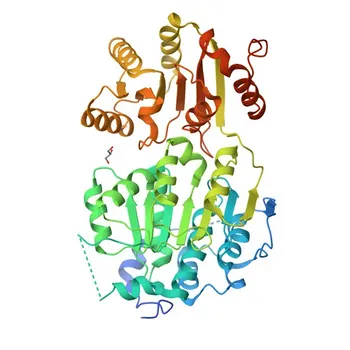
The Most Important Letter in a Sequencing Reaction Is the One That Stops
A sequencing assay does not read DNA by watching a molecule grow indefinitely.
It reads DNA by creating many versions of the same molecule, each stopped at a different point.
Imagine a diagnostic laboratory examining a suspected single-nucleotide variant. The difference between a reliable call and an ambiguous peak may be only one chemical group on one sugar molecule. That group is the 3'-hydroxyl, or 3'-OH, and its absence is what gives dideoxynucleotides their power.
A dideoxynucleotide, or ddNTP, is a molecular stop signal. Once DNA polymerase incorporates it into a growing strand, extension ends permanently at that base.
This simple interruption turns enzymatic replication into a method for reconstructing genetic information one position at a time.
The Missing Chemical Handle
DNA polymerase joins nucleotides through phosphodiester bonds. To extend a DNA strand, it needs a reactive 3'-OH group at the end of the existing chain.
That hydroxyl acts as the nucleophile. It attacks the alpha-phosphate of the incoming nucleotide, allowing the next nucleotide to become part of the DNA backbone.
A standard deoxynucleotide, or dNTP, contains this essential group.
A ddNTP does not.
The 3'-OH has been replaced by a hydrogen atom:
| Feature | Standard dNTP | ddNTP |
|---|---|---|
| 3' position | Contains a reactive hydroxyl group | Contains an inert hydrogen atom |
| Chain behavior | Supports continued extension | Causes permanent termination |
| Base identity | A, T, C, or G | A, T, C, or G |
| Triphosphate group | Present | Present |
| Primary sequencing role | Builds the DNA strand | Marks the position where synthesis stops |
The modification is small enough to preserve base-pairing behavior and triphosphate chemistry.
It is also decisive enough to stop the reaction.
How a Polymerase Becomes a Sequencing Instrument
DNA polymerase is not designed to interpret a sequence for a scientist. Its natural task is narrower: find the correct base, incorporate it, and continue.
Sanger sequencing uses that ordinary behavior under carefully controlled conditions.
The reaction contains:
- A DNA template
- A primer
- DNA polymerase
- Standard dNTPs
- A controlled quantity of fluorescently labeled ddNTPs
Most of the time, polymerase incorporates a standard dNTP and continues along the template.
Occasionally, it incorporates a ddNTP.
At that moment, the strand cannot accept another nucleotide. The fragment stops at a position corresponding to the incorporated base.
Across millions of molecules, termination occurs at many positions along the template. The reaction therefore produces a population of fragments with:
- The same starting point
- Different lengths
- A terminal base that identifies the stopping position
This is the foundation of the sequencing ladder.
From Fragment Length to Genetic Meaning
The fragments are separated by capillary electrophoresis.
Shorter fragments move through the capillary first. Longer fragments arrive later. As each fluorescently labeled fragment passes the detector, its color identifies the terminal nucleotide.
The instrument converts this ordered signal into an electropherogram.
The logic is elegant:
- Fragment length reveals the position in the sequence.
- Fluorescent label reveals the identity of the terminal base.
- The ordered signal reconstructs the DNA sequence.
A peak is not merely a visual feature on a screen. It is the final expression of several preceding events:
- Correct primer binding
- Accurate template copying
- Appropriate polymerase activity
- Balanced dNTP and ddNTP incorporation
- Stable fluorescent labeling
- Effective fragment separation
- Reliable signal detection
When the trace is clean, the chemistry disappears from view.
When the trace is poor, every hidden dependency becomes visible.
Why Purity Determines Whether the Ladder Can Be Read
A sequencing reaction can fail even when the overall protocol appears correct.
One common cause is contamination of the ddNTP preparation with standard dNTPs. A molecule intended to terminate a strand may be replaced by a nucleotide that allows extension to continue. The result is an uneven or incomplete fragment distribution.
The electropherogram may then show:
- Weak or missing peaks
- Ambiguous base calls
- Irregular signal intensity
- Elevated background noise
- Reduced confidence near difficult regions
Purity is therefore not an abstract specification. It determines whether the molecular stop signal occurs where it is supposed to occur.
For clinical diagnostics, that distinction matters. A noisy trace can create uncertainty around a single nucleotide, but the reported result may influence treatment decisions, confirmatory testing, or product release.
The smallest impurity can therefore become a systems-level problem.
The Ratio That Controls the Read
The ddNTP-to-dNTP ratio is another critical variable.
If the reaction contains too much ddNTP, termination occurs too early and too often. The resulting fragments are predominantly short, limiting sequence coverage and obscuring downstream bases.
If the reaction contains too little ddNTP, most strands become excessively long. The reaction produces fewer fragments at the intermediate positions needed for a balanced read.
A commonly used starting point is approximately 1% ddNTP relative to standard dNTPs. That figure is not a universal recipe. It is a formulation parameter that must be validated against the complete assay system.
The correct balance depends on factors such as:
- Template length
- GC content
- Secondary structure
- Polymerase processivity
- Primer design
- Label chemistry
- Target sequence
- Required read quality
A reagent ratio that performs well for one amplicon may produce a different signal profile for another.
This is where sequencing changes from a chemical reaction into an engineering problem.
Polymerase Selectivity Can Create Hidden Bias
Polymerases do not necessarily incorporate all four ddNTPs with equal efficiency.
Many native enzymes recognize the missing 3'-OH as a structural defect and discriminate against ddNTPs. Even engineered enzymes may show different affinities for ddATP, ddTTP, ddCTP, and ddGTP.
That creates incorporation bias.
One base may terminate frequently and produce strong peaks. Another may terminate inefficiently and produce weak peaks or gaps. The final trace can look like a problem with the template when the real problem lies in enzyme-substrate compatibility.
Sequencing-grade polymerases are often engineered to improve:
- ddNTP acceptance
- Incorporation balance
- Processivity
- Thermal stability
- Performance across difficult templates
- Compatibility with fluorescent terminators
The enzyme and the terminators should be evaluated as a functional pair, not as isolated catalog items.
A new lot of ddNTPs can alter peak balance even when the polymerase has not changed. Conversely, a new polymerase can change the effective termination profile of a familiar reagent mix.
The assay sees the combination.
The Psychology of a Peak
Scientists are trained to trust instruments because instruments appear objective.
But a peak is not the truth itself. It is evidence produced by a chain of assumptions.
The operator assumes that the terminal label is intact. The analyst assumes that the fragments are evenly represented. The manufacturer assumes that the lot behaves like the previous lot. The clinician assumes that the base call reflects the patient’s sample rather than reagent variation.
That is why reproducibility has a psychological dimension.
When a result is difficult to interpret, people tend to search for a dramatic explanation: a rare mutation, a contaminated sample, an unusual biological structure. Less visible causes, such as subtle reagent drift, are easier to overlook.
Strong assay design reduces the number of stories the data can tell.
Consistent ddNTP quality narrows uncertainty before the electropherogram reaches the analyst.
What Quality Means in Different Workflows
The “best” ddNTP is defined by the risk the assay must control.
Clinical Variant Calling
Clinical applications place the highest priority on accurate termination and low background noise.
Important considerations include:
- High chemical purity
- Confirmed molecular identity
- Stable fluorescent label integrity
- Balanced incorporation across all four bases
- Lot-specific analytical documentation
- Functional validation in the intended assay system
A reagent that is merely usable in research may not provide sufficient evidence for a regulated diagnostic workflow.
IVD Kit Manufacturing
For kit manufacturers, quality includes continuity.
A reagent must perform consistently across production lots, qualification runs, stability studies, and customer laboratories. A small change in peak balance can create downstream costs in troubleshooting, lot release, technical support, and regulatory documentation.
Manufacturers should evaluate:
| Manufacturing concern | Why it matters |
|---|---|
| Lot-to-lot consistency | Preserves assay performance after production changes |
| Enzyme/ddNTP compatibility | Reduces incorporation bias and peak imbalance |
| Documentation | Supports qualification and quality records |
| Packaging and storage | Protects light-sensitive and hydrolysis-prone materials |
| Supply continuity | Prevents avoidable interruptions in production |
| Technical support | Speeds investigation when performance shifts |
The reagent supplier becomes part of the manufacturing system.
Reliability is not just the ability to deliver a box. It is the ability to preserve assay behavior over time.
Research and Assay Validation
In research, ddNTP sequencing remains valuable for checking recombinant constructs, cloned inserts, plasmids, and amplified targets.
Before scaling a production process, researchers need to know whether the template is correct. A single mutation introduced during cloning or amplification can propagate through an entire downstream workflow.
Sanger sequencing provides a practical checkpoint.
The cost of this checkpoint is small compared with the cost of expanding a flawed construct, validating the wrong assay, or discovering a sequence error after manufacturing has begun.
Stability Is Part of the Chemistry
Fluorescently labeled ddNTPs are more complex than standard nucleotide reagents.
They can be sensitive to:
- Light exposure
- Temperature variation
- Repeated freeze-thaw cycles
- Hydrolysis
- Incompatible storage conditions
- Extended handling outside validated limits
A high-purity reagent can still become an unreliable reagent if its chemical state changes during transport or storage.
This makes logistics part of analytical performance.
A robust supply program should connect the material specification with practical controls:
- Appropriate light-protective packaging
- Clearly defined storage conditions
- Controlled shipment requirements
- Traceable lot documentation
- Stability information
- Defined handling recommendations
The most sophisticated assay cannot compensate for a reagent that has degraded before it enters the reaction.
A Practical Evaluation Framework
When selecting ddNTPs for a sequencing workflow, begin with the assay’s actual failure modes.
Ask five questions:
-
What must the assay distinguish?
Is the goal sequence confirmation, variant calling, quality control, or clinical reporting? -
Where could termination become biased?
Consider polymerase compatibility, target composition, and difficult sequence regions. -
What evidence supports the material?
Review purity data, identity confirmation, label integrity, and functional validation. -
How will lot changes be controlled?
Define acceptance criteria for peak balance, read length, background, and base-call quality. -
Can the supply chain support the product lifecycle?
Consider scale-up, replenishment, documentation, technical communication, and continuity.
This framework shifts the decision away from unit price alone.
The relevant cost is the cost of uncertainty: failed runs, delayed release, repeated validation, and incorrect interpretation.
ddNTPs as Controlled Information
A ddNTP does not add information by itself.
It creates a boundary.
By stopping synthesis at a defined base, it converts a continuous molecular process into a series of measurable events. The sequence becomes visible because the reaction has been forced to end in an orderly way.
That is the deeper engineering lesson.
Reliable measurement often depends less on collecting more signal than on controlling where a process stops.
In Sanger sequencing, the 3'-OH is the difference between continuation and termination. In assay development, purity and stoichiometry are the difference between a readable trace and a persuasive-looking mistake. In manufacturing, lot consistency is the difference between a validated process and a process that must be rediscovered each time materials change.
CamelBio supports diagnostic manufacturers, laboratories, and research institutes with one-stop access to IVD raw materials, technical services, and consulting across the path from concept to clinic. For sequencing workflows where reagent quality must become dependable evidence, connect with Contact Our Experts.
Related Products
Related Articles
- ROX in qPCR: The Quiet Reference That Makes Diagnostic Signals Trustworthy
- ROX in Real-Time PCR: The Optical Trade-Off Behind Precision and Multiplexing
- From Fluorescence to Diagnostic Truth: Choosing Passive Reference Dyes for qPCR Master Mixes
- Specificity Is Built in Gates: A Hybridoma Screening Workflow for Reliable Immunoassay Raw Materials
- ROX, Optical Architecture, and the Hidden Ceiling of Multiplex qPCR