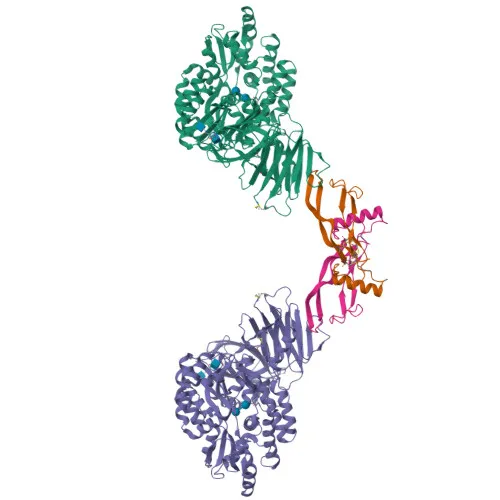
Monoclonal Antibodies
Rabbit anti-Human CD105/Endoglin Monoclonal Antibody for Flow Cytometry - P17813
Item Number : CM0004053
Price varies based on specs and customizations
- Application
- FC
- Cross Reactivity
- Human
- Protein Weight
- 67kDa/70kDa

Shipping:
Contact us to get shipping details Enjoy On-time Dispatch Guarantee.
Why Choose Us
Easy ordering process, quality products, and dedicated support for your business success.
Core Product Specifications and Parameters
| Parameter | Value |
|---|---|
| Product Name | Rabbit anti-Human CD105/Endoglin mAb |
| Remarks/Alias | ENG; END; HHT1; ORW1; endoglin |
| Species | human |
| GeneID | 2022 |
| Immunogen | Recombinant fusion protein containing a sequence corresponding to amino acids 26-337 of human CD105/Endoglin (NP_001108225.1) |
| Source | Rabbit |
| Category | Monoclonal Antibodies |
| Application | FC |
| Cross Reactivity | Human |
| SWISS | P17813 |
| Protein Weight | 67kDa/70kDa |
| Shipping | Ice bag |
Biological Background: Endoglin Function and Localization
- Endoglin (CD105) is a vascular endothelial glycoprotein essential for angiogenesis, regulating endothelial cell migration and maintaining adult vasculature integrity.
Related references: PMID:7894484, PMID:17540773 - It functions as a TGF-beta/BMP coreceptor, modulating SMAD signaling in response to ligands such as GDF2/BMP9 and TGFB1, influencing processes like proliferation and differentiation.
Related references: PMID:21737454, PMID:22347366, PMID:23300529 - Endoglin is required for extraembryonic angiogenesis and embryonic heart development, and may regulate endothelial cell shape changes in response to blood flow during vascular remodeling.
- Mutations in the ENG gene are associated with hereditary hemorrhagic telangiectasia type 1 (HHT1), highlighting its critical role in vascular homeostasis.
- Subcellularly, endoglin localizes to the cell membrane and is expressed on endothelial cells, with detection in placenta and umbilical vein endothelial cells.
- The protein undergoes alternative splicing, glycosylation, and phosphorylation, and contains disulfide bonds; it is a single-pass type I membrane protein.
Experimental Guidance and Technical Tips
- The immunogen corresponds to amino acids 26-337 of human CD105/Endoglin (extracellular domain), suggesting the antibody recognizes an epitope accessible on live, unfixed cells. For flow cytometry, titrate the antibody to determine the optimal staining concentration for your target cell population.
- Include appropriate controls such as isotype control antibodies and fluorescence-minus-one (FMO) controls. If working with Fc receptor-expressing cells, consider pre-incubation with Fc block.
- Validation of expression levels in your specific cell type (e.g., HUVECs or other endothelial lines) is recommended, as endoglin expression can vary with activation state.
CamelBio: Your One-Stop Sourcing Bridge
CamelBio is a trusted one-stop supplier of IVD raw materials, supporting diagnostic manufacturers and researchers from concept to clinic. For your CD105/Endoglin research, we offer validated monoclonal and polyclonal antibodies, bulk reagent sourcing, and custom conjugation services. Whether you need matched antibody pairs, rare target reagents, or technical consultation, CamelBio streamlines your procurement with quality-assured solutions.
Product Datasheet
Rabbit anti-Human CD105/Endoglin Monoclonal Antibody for Flow Cytometry - P17813
REQUEST A QUOTE
Our professional team will reply to you within one business day. Please feel free to contact us!