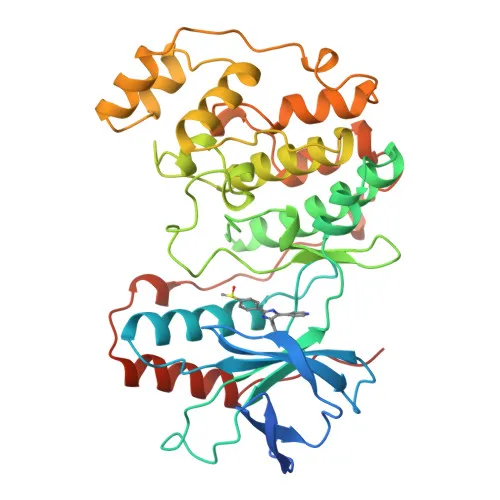
Phosphorylated Antibodies
Phospho-p38 MAPK (T180/Y182) Rabbit Polyclonal Antibody for WB, IHC-P, ELISA - Q16539
Item Number : CM0001283
Price varies based on specs and customizations
- Application
- WB, IHC-P, ELISA
- Cross Reactivity
- Human, Mouse, Rat
- Protein Weight
- 41kDa

Shipping:
Contact us to get shipping details Enjoy On-time Dispatch Guarantee.
Why Choose Us
Easy ordering process, quality products, and dedicated support for your business success.
Core Product Specifications and Parameters
| Parameter | Value |
|---|---|
| Product Name | Phospho-p38 MAPK-T180/Y182 Rabbit pAb |
| Remarks/Alias | RK; p38; CSBP; EXIP; Mxi2; CSBP1; CSBP2; CSPB1; PRKM14; PRKM15; SAPK2A; p38ALPHA; Phospho-p38 MAPK-T180/Y182 |
| Species | Human |
| Gene ID (Human) | 1432 |
| Immunogen | A synthetic phosphorylated peptide around T180 & Y182 of human p38 MAPK (NP_620581.1) |
| Source | Rabbit |
| Category | Phosphorylated Antibodies |
| Application | WB, IHC-P, ELISA |
| Cross Reactivity | Human, Mouse, Rat |
| SWISS | Q16539 |
| Protein Weight | 41kDa |
| Shipping | Ice bag |
Biological Background: p38 MAPK (MAPK14) Function and Localization
- Mitogen-activated protein kinase 14 (MAPK14), also known as p38 alpha, is a serine/threonine kinase encoded by the MAPK14 gene. Alternative splicing gives rise to isoforms including MXI2 and EXIP, which display distinct substrate preferences and roles in mitogenic and apoptotic signaling.
- MAPK14 is primarily localized in both the cytoplasm and nucleus, allowing it to transduce extracellular signals to nuclear transcription factors and modulate cytoplasmic processes such as protein turnover and endocytosis.
- Upon dual phosphorylation at Thr180 and Tyr182, MAPK14 activates downstream effectors like RPS6KA5/MSK1 and RPS6KA4/MSK2. These kinases phosphorylate transcription factors (CREB1, ATF1, RELA/NFKB3) and chromatin components such as histone H3 at Ser10, facilitating immediate-early gene induction (PubMed:9687510, PubMed:9792677). Related references: PMID:9687510, PMID:9792677
- In addition to transcriptional control, p38 MAPK regulates gene expression post-transcriptionally. It activates MAPKAPK2/MK2 and MAPKAPK3/MK3 to phosphorylate mRNA-binding proteins (e.g., ZFP36, ELAVL1) and modulates translation via MNK1/MNK2-mediated phosphorylation of EIF4E2 (PubMed:11154262). Related references: PMID:11154262
- MAPK14 influences protein degradation and membrane receptor trafficking. It phosphorylates the ubiquitin ligase SIAH2 (PubMed:17003045), controls EGFR endocytosis through RAB5A effectors (PubMed:16932740), and promotes ectodomain shedding of ligands by activating the metalloprotease ADAM17 (PubMed:20188673). Related references: PMID:17003045, PMID:16932740, PMID:20188673
- The kinase is critical for stress-induced erythropoiesis and placental development, as evidenced by its role in EPO gene expression and fetal blood vessel growth (PubMed:10943842). It also participates in apoptosis and pyroptosis; the EXIP isoform may promote apoptosis, while full-length MAPK14 phosphorylates NLRP1 to trigger inflammasome activation (PubMed:35857590). Related references: PMID:10943842, PMID:35857590
- During M. tuberculosis infection, MAPK14 is targeted by the bacterial effector EsxA, leading to phosphorylation-dependent inhibition of IFN-gamma production in T-cells (PubMed:21586573). Related references: PMID:21586573
Experimental Guidance and Technical Tips
- The immunogen was a synthetic phosphorylated peptide encompassing Thr180 and Tyr182 of human p38 MAPK. For western blot (WB) and immunohistochemistry (IHC-P), consider using fresh or properly preserved samples with phosphatase inhibitors to maintain phosphorylation signals.
- For ELISA applications, inclusion of a non-phosphorylated peptide control or lambda phosphatase treatment may help verify phospho-specificity.
- The predicted molecular weight is 41 kDa. In induced cell lysates (e.g., anisomycin- or UV-treated HeLa, HEK293T cells), a band of this size should appear; confirm by parallel detection with a pan-p38 antibody.
- Cross-reactivity is reported for human, mouse, and rat. Validate in your specific sample type and species to confirm reactivity and optimal dilution.
- This antibody has not been tested in other applications such as immunoprecipitation (IP) or immunofluorescence (IF); pilot experiments are recommended if other uses are desired.
CamelBio: Your One-Stop Sourcing Bridge
CamelBio serves as a comprehensive IVD raw-material partner, offering validated antibody pairs, monoclonal and polyclonal antibodies, bulk ancillary reagents, and custom sourcing for rare targets. This phospho-p38 MAPK antibody is suitable for research into inflammatory signaling, stress responses, and oncology, and CamelBio can supply complementary reagents to accelerate your diagnostic development. From initial feasibility to commercial scale-up, CamelBio provides end-to-end support for your assay needs.
REQUEST A QUOTE
Our professional team will reply to you within one business day. Please feel free to contact us!