Phosphorylated Antibodies
Phospho-Na+/K+-ATPase-S16 Rabbit pAb for WB - P05023
Item Number : CM0001352
Price varies based on specs and customizations
- Application
- WB, ELISA
- Cross Reactivity
- Human, Mouse, Rat
- Protein Weight
- 113kDa

Shipping:
Contact us to get shipping details Enjoy On-time Dispatch Guarantee.
Why Choose Us
Easy ordering process, quality products, and dedicated support for your business success.
Core Product Specifications and Parameters
| Parameter | Specification |
|---|---|
| Product Name | Phospho-Na+/K+-ATPase-S16 Rabbit pAb |
| Remarks/Alias | CMT2DD; HOMGSMR2; Phospho-Na+/K+-ATPase-S16 |
| Species | Human |
| Gene ID | 476 (ATP1A1) |
| Immunogen | A synthetic phosphorylated peptide around S16 of human Na+/K+-ATPase (NP_000692.2) |
| Source | Rabbit |
| Category | Phosphorylated Antibodies |
| Application | WB, ELISA |
| Cross Reactivity | Human, Mouse, Rat |
| SWISS | P05023 |
| Protein Weight | 113kDa |
| Shipping | Ice bag |
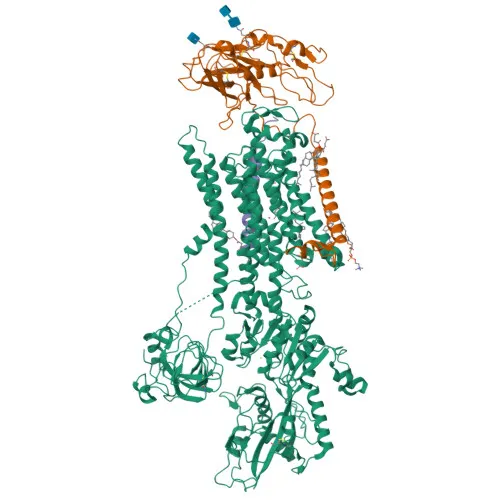
Biological Background: ATP1A1 (Na+/K+-ATPase subunit alpha-1) Function and Localization
- Catalyzes the active transport of Na+ out of and K+ into the cell, establishing electrochemical gradients critical for membrane potential, nutrient uptake, and cell volume control. Related references: PMID:29499166, PMID:30388404, PMID:35803952
- Undergoes E1/E2 conformational transitions powered by ATP hydrolysis, alternating ion binding and release to drive 3 Na+ out / 2 K+ in per cycle. Related references: PMID:35803952
- Member of the P-type ATPase family with ten transmembrane domains and intracellular ATP-binding and phosphorylation sites; the alpha-1 subunit is the most ubiquitously expressed isoform.
- Localized primarily at the basolateral membrane in epithelia, sarcolemma of muscle, axonal projections, and melanosomes, matching its roles in transepithelial transport and excitability.
- Phosphorylation at Ser16 (as detected by this antibody) is a regulatory modification; the protein is also acetylated and undergoes alternative splicing affecting its function.
- Mutations in ATP1A1 are linked to Charcot-Marie-Tooth disease type 2DD, hypomagnesemia, epilepsy, and intellectual disability, underscoring its importance in the nervous system.
Experimental Guidance and Technical Tips
- Raised against a phosphorylated peptide around Ser16, this antibody is expected to recognize the endogenous protein only when phosphorylated at this site. Validate specificity by comparing signals from phosphatase-treated and untreated samples.
- For Western blot, prepare lysates with phosphatase inhibitors and consider using a non-phospho blocking peptide to confirm band identity.
- In ELISA, use the immunogen phospho-peptide and a non-phospho counterpart to assess cross-reactivity.
- The antibody cross-reacts with human, mouse, and rat; titrate for each species as expression levels may differ.
- As a polyclonal antibody, lot-to-lot variation can occur; re-validate in your assay when receiving a new lot.
CamelBio: Your One-Stop Sourcing Bridge
CamelBio serves as your comprehensive sourcing bridge for IVD raw materials, offering everything from validated antibody pairs and optimized polyclonal/monoclonal antibodies to bulk ancillary reagents and custom rare-target sourcing. This phospho-specific ATP1A1 antibody exemplifies our commitment to supporting ion transport and neurology-focused research and diagnostic development.
REQUEST A QUOTE
Our professional team will reply to you within one business day. Please feel free to contact us!