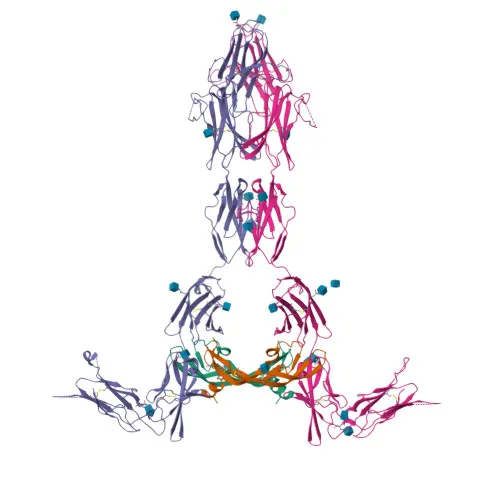
Monoclonal Antibodies
Anti-VEGF Rabbit Monoclonal Antibody for WB, IF/ICC, ELISA - P15692
Item Number : CM0004342
Price varies based on specs and customizations
- Application
- WB, IF/ICC, ELISA
- Cross Reactivity
- Human, Mouse, Rat
- Protein Weight
- 15-27kDa/34-45kDa

Shipping:
Contact us to get shipping details Enjoy On-time Dispatch Guarantee.
Why Choose Us
Easy ordering process, quality products, and dedicated support for your business success.
Core Product Specifications and Parameters
| Parameter | Value |
|---|---|
| Product Name | VEGF Rabbit mAb |
| Remarks/Alias | VEGFA, MVCD1, VEGF, VPF, vascular endothelial growth factor A |
| Species | Human |
| GeneID (Human) | 7422 |
| GeneID | 7422 |
| Immunogen | Recombinant fusion protein containing a sequence corresponding to amino acids 38-135 of human VEGF (NP_001165094.1) |
| Source | Rabbit |
| Category | Monoclonal Antibodies |
| Application | WB, IF/ICC, ELISA |
| Cross Reactivity | Human, Mouse, Rat |
| SWISS | P15692 |
| Protein Weight | 15-27kDa/34-45kDa |
| Shipping | Ice bag |
Biological Background: VEGF Function and Localization
- VEGF is a key growth factor that induces angiogenesis, vasculogenesis, and endothelial cell proliferation, migration, and survival; it also increases vascular permeability (PubMed:34530889). It binds to receptors FLT1/VEGFR1, KDR/VEGFR2, heparan sulfate, heparin, and NRP1/neuropilin-1 (By similarity), as well as the DEAR/FBXW7-AS1 receptor (PubMed:17446437). Related references: PMID:34530889 PMID:17446437
- VEGF plays a critical role in the cellular response to hypoxia by inducing HIF1A and protecting cells from hypoxia-mediated cell death (PubMed:35455969; By similarity). Related references: PMID:35455969
- An isoform of VEGF binds KDR but does not activate downstream signaling, thereby inhibiting angiogenesis and suppressing tumor growth.
- The protein localizes to the cytoplasm and nucleus, and is secreted into the extracellular space, including the endoplasmic reticulum, Golgi, and extracellular matrix.
- VEGF is widely expressed, with higher levels observed in pituitary tumors compared to normal pituitary gland.
- The gene undergoes alternative splicing and alternative promoter usage, producing multiple isoforms with distinct functions; post-translational modifications include glycosylation and disulfide bond formation.
Experimental Guidance and Technical Tips
- For Western blotting, consider running samples under both reducing and non-reducing conditions to observe monomeric (~15-27 kDa) and dimeric (~34-45 kDa) VEGF forms; the product may detect bands corresponding to these molecular weights.
- Validate antibody specificity and cross-reactivity in the relevant species (human, mouse, rat) and application system by including appropriate controls.
- In immunofluorescence/ICC, optimize permeabilization protocols to detect intracellular VEGF pools.
- For ELISA, pair this antibody with a suitable capture or detection reagent and confirm performance with recombinant VEGF standards.
CamelBio: Your One-Stop Sourcing Bridge
CamelBio is your one-stop partner for IVD raw-material sourcing, supplying high-quality antibodies, antigen pairs, and ancillary reagents from research to manufacturing. With this anti-VEGF monoclonal antibody, we support angiogenesis and hypoxia research—and can source validated antibody pairs, optimized monoclonal/polyclonal formats, bulk reagents, and even rare-target raw materials to accelerate your diagnostic development.
REQUEST A QUOTE
Our professional team will reply to you within one business day. Please feel free to contact us!