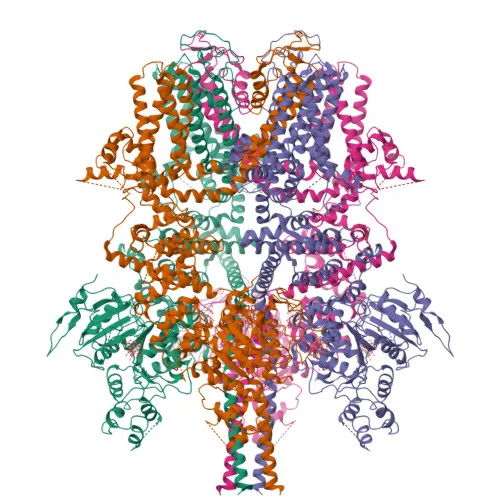
Polyclonal Antibodies
Anti-TRPM4 Polyclonal Antibody for WB, ELISA - Q8TD43
Item Number : CM0015822
Price varies based on specs and customizations
- Application
- WB, ELISA
- Cross Reactivity
- Human, Mouse, Rat
- Protein Weight
- 134kDa

Shipping:
Contact us to get shipping details Enjoy On-time Dispatch Guarantee.
Why Choose Us
Easy ordering process, quality products, and dedicated support for your business success.
Core Product Specifications and Parameters
| Parameter | Value |
|---|---|
| Product Name | TRPM4 Rabbit pAb |
| Remarks/Alias | EKVP6; LTrpC4; PFHB1B; TRPM4B; hTRPM4; TRPM4 |
| Species | Human |
| Gene ID | 54795 |
| Immunogen | Recombinant fusion protein containing a sequence corresponding to amino acids 1-240 of human TRPM4 (NP_060106.2). |
| Source | Rabbit |
| Category | Polyclonal Antibodies |
| Application | WB, ELISA |
| Cross Reactivity | Human, Mouse, Rat |
| SWISS | Q8TD43 |
| Protein Weight | 134kDa |
| Shipping | Ice bag |
Biological Background: TRPM4 Function and Localization
- TRPM4, also known as melastatin-4 or LTrpC4, is a member of the transient receptor potential (TRP) channel family and functions as a calcium-activated non-selective cation channel.
- It mediates membrane depolarization by conducting monovalent cations (relative permeability: Na+ > K+ > Cs+ > Li+), while being impermeable to Ca2+ itself. Related references: PMID:12015988 PMID:12842017 PMID:29211723
- TRPM4 plays essential roles in diverse tissues: it contributes to pacemaking activity in cardiomyocytes, insulin secretion in pancreatic beta-cells, myogenic constriction of cerebral arteries, and neuronal function in entorhinal cortex and sensory neurons.
- In the immune system, it regulates T-cell activation by modulating Ca2+ oscillations required for NFAT-dependent IL2 production, and differentially controls T-helper 1 (Th1) and Th2 cell motility and cytokine production.
- TRPM4 enhances cell proliferation through up-regulation of the beta-catenin signaling pathway and is involved in keratinocyte differentiation. Related references: PMID:30528822
- The protein localizes to the cell membrane, endoplasmic reticulum, and Golgi apparatus, and is subject to post-translational modifications including glycosylation, phosphorylation, and ubiquitination.
- Widely expressed with highest levels in intestine and prostate, it is also prominently found in Purkinje fibers of the heart, Th2 cells, and keratocytes.
- Mutations in TRPM4 are associated with progressive familial heart block type IB (PFHB1B) and palmoplantar keratoderma, underscoring its importance in cardiac conduction and skin homeostasis.
- Alternative splicing produces isoforms; some variants may lack channel activity.
Experimental Guidance and Technical Tips
- The immunogen is the N-terminal region (aa 1-240) of human TRPM4, which may detect multiple splice isoforms.
- For Western blot, expect a band near 134 kDa; validate with positive controls from human, mouse, or rat tissues known to express TRPM4.
- In ELISA, test antibody dilution series and optimize coating antigen concentration to achieve the desired sensitivity.
- Pre-adsorption or blocking peptides can be used to confirm band specificity in WB.
CamelBio: Your One-Stop Sourcing Bridge
CamelBio provides diagnostic manufacturers and research laboratories with streamlined access to high-quality IVD raw materials. This anti-TRPM4 polyclonal antibody supports investigations into cardiac electrophysiology, ion channel disorders, and immune cell signaling. Beyond individual antibodies, our portfolio includes validated antibody pairs, optimized monoclonal/polyclonal antibodies, bulk ancillary reagents, and custom sourcing for challenging targets, enabling a seamless transition from concept to clinical application.
REQUEST A QUOTE
Our professional team will reply to you within one business day. Please feel free to contact us!