Polyclonal Antibodies
Anti-THOC3 Polyclonal Antibody for WB, ELISA - Q96J01
Item Number : CM0013572
Price varies based on specs and customizations
- Application
- WB, ELISA
- Cross Reactivity
- Human, Mouse
- Protein Weight
- 39kDa

Shipping:
Contact us to get shipping details Enjoy On-time Dispatch Guarantee.
Why Choose Us
Easy ordering process, quality products, and dedicated support for your business success.
Core Product Specifications and Parameters
| Parameter | Value |
|---|---|
| Product Name | THOC3 Rabbit pAb |
| Remarks/Alias | THO3; hTREX45; THOC3 |
| Species | Human |
| GeneID (Human) | 84321 |
| GeneID | 84321 |
| Immunogen | Recombinant protein |
| Source | Rabbit |
| Category | Polyclonal Antibodies |
| Application | WB, ELISA |
| Cross Reactivity | Human, Mouse |
| SWISS | Q96J01 |
| Protein Weight | 39kDa |
| Shipping | Ice bag |
Biological Background: THOC3 Function and Localization
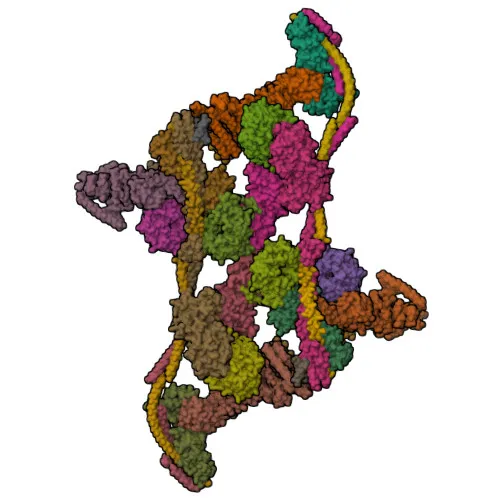
- THOC3 (THO3, hTREX45) encodes a WD repeat-containing subunit of the THO subcomplex within the TREX (transcription/export) complex, which preferentially binds spliced mRNA and couples transcription to nuclear export. Related references: PMID:15833825 PMID:15998806 PMID:17190602
- The protein is required for efficient export of polyadenylated RNA and spliced mRNA; depletion of THOC3 impairs both processes. Related references: PMID:23222130
- Together with THOC1 and THOC2, the core THOC3 complex directly binds the export factor NXF1-NXT1 and stimulates the ATPase activity of DDX39B to drive mRNA export. Related references: PMID:33191911
- TREX is recruited to mature mRNAs via a splicing- and cap-dependent mechanism that is independent of ongoing transcription, positioning the complex near the 5′ end for TAP/NXF1-mediated nuclear export. Related references: PMID:15833825 PMID:15998806 PMID:17190602
- Localizes to the nucleus and concentrates in nuclear speckles, consistent with its role in mRNA processing and export.
- The TREX complex is exploited by viruses; it is essential for the nuclear export of Kaposi’s sarcoma-associated herpesvirus (KSHV) intronless mRNAs and for productive infection.
- Post-translational modifications include acetylation, and alternative splicing generates multiple isoforms, potentially modulating complex assembly or function.
Experimental Guidance and Technical Tips
- The immunogen targets the N-terminal region (aa 1-200), encompassing WD40 repeat motifs; consider this when interpreting epitope accessibility.
- For Western blot, a predicted band size of ~39 kDa (human THOC3) should be observed under reducing conditions; validate in cell lines expressing THOC3 (e.g., HeLa, HEK293) or appropriate mouse tissue.
- When performing ELISA, optimize coating antigen concentration and antibody dilution to reduce background.
- Monitor possible band shifts due to post-translational modifications (acetylation) or alternative splicing variants.
- Cross-reactivity with mouse THOC3 allows for translational studies; verify cross-reactivity in your specific experimental setup.
CamelBio: Your One-Stop Sourcing Bridge
CamelBio provides integrated sourcing solutions for IVD raw materials, offering validated antibodies like this THOC3 polyclonal antibody alongside complementary reagents for mRNA processing and gene expression research. Whether you need antibody pairs, bulk ancillary reagents, or hard-to-find monoclonal antibodies for diagnostic assay development, CamelBio streamlines procurement from discovery to clinical translation.
REQUEST A QUOTE
Our professional team will reply to you within one business day. Please feel free to contact us!