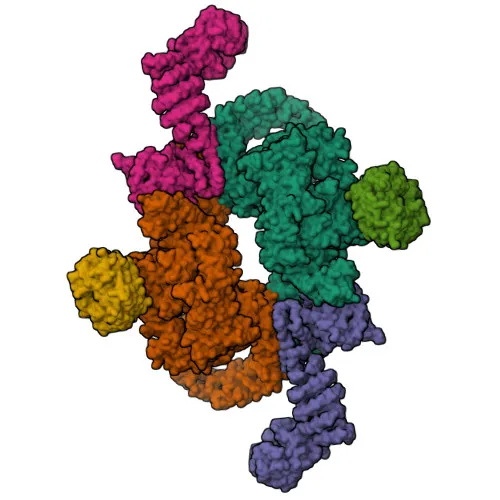
Polyclonal Antibodies
Anti-Raptor Rabbit Polyclonal Antibody for WB, IHC-P, IF/ICC, ELISA - Q8N122
Item Number : CM0023567
Price varies based on specs and customizations
- Application
- WB, IHC-P, IF/ICC, ELISA
- Cross Reactivity
- Human, Mouse, Rat
- Protein Weight
- 149kDa

Shipping:
Contact us to get shipping details Enjoy On-time Dispatch Guarantee.
Why Choose Us
Easy ordering process, quality products, and dedicated support for your business success.
Core Product Specifications and Parameters
| Parameter | Value |
|---|---|
| Product Name | Raptor Rabbit pAb |
| Remarks/Alias | KOG1; Mip1; Raptor |
| Species | Human |
| Gene ID (Human) | 57521 |
| Gene ID | 57521 |
| Immunogen | Recombinant fusion protein containing a sequence corresponding to amino acids 888-1013 of human RPTOR (NP_065812.1). |
| Source | Rabbit |
| Category | Polyclonal Antibodies |
| Application | WB, IHC-P, IF/ICC, ELISA |
| Cross Reactivity | Human, Mouse, Rat |
| SWISS | Q8N122 |
| Protein Weight | 149kDa |
| Shipping | Ice bag |
Biological Background: Raptor Function and Localization
- Raptor (regulatory-associated protein of mTOR) is a core component of the mechanistic target of rapamycin complex 1 (mTORC1), which functions as a central nutrient sensor to stimulate anabolic reactions and macromolecule biosynthesis, thereby promoting cell growth and proliferation. Related references: PMID:12150925 PMID:12150926 PMID:12747827
- In response to nutrients, growth factors, or amino acids, mTORC1 is recruited to the lysosome membrane and phosphorylates key substrates such as RPS6KB1, EIF4EBP1, ULK1, ATG13, and TFEB, coordinating protein and lipid synthesis while suppressing autophagy. Related references: PMID:12150925 PMID:12150926 PMID:12747827
- Raptor serves a dual adapter role: it mediates lysosomal recruitment of mTORC1 via interaction with Rag GTPases (RRAGA/B/C/D) and acts as a substrate-specific adapter by binding TOS motif-containing proteins, directing them to the MTOR kinase domain for phosphorylation. Related references: PMID:12747827 PMID:24403073 PMID:26588989
- The mTORC1 complex also regulates cellular differentiation processes such as odontoblast and osteoclast differentiation and plays a role in excitatory neuronal transmission, including prosocial behavior induced by lysergic acid diethylamide (LSD).
- Subcellularly, Raptor localizes to the lysosome membrane, cytoplasm, and cytoplasmic granules, consistent with its dynamic signaling functions.
- Raptor is highly expressed in skeletal muscle, with moderate expression in brain, lung, small intestine, kidney, and placenta. It is widely expressed, with highest levels in nasal mucosa and pituitary.
- The protein undergoes multiple post-translational modifications including acetylation and phosphorylation, and contains WD repeats and a Ubl conjugation domain. Alternative splicing generates additional isoforms.
Experimental Guidance and Technical Tips
- The immunogen corresponds to amino acids 888–1013 (C-terminal region) of human RPTOR. The resulting polyclonal antibody is expected to recognize multiple epitopes, potentially offering robust detection across applications.
- For Western blotting (WB), the target protein has a predicted molecular weight of approximately 149 kDa; use an appropriate gel percentage and transfer conditions for high-molecular-weight proteins.
- In immunohistochemistry (IHC-P), antigen retrieval may be required; optimize fixation and retrieval methods for the tissue of interest.
- For immunofluorescence (IF/ICC) and ELISA, standard protocols can be considered; include appropriate positive and negative controls to validate performance.
- The antibody shows cross-reactivity with mouse and rat, making it suitable for animal model studies.
CamelBio: Your One-Stop Sourcing Bridge
CamelBio is a dedicated one-stop partner for IVD raw material sourcing, supporting diagnostic manufacturers, laboratories, and research institutes with validated antibody pairs, optimized monoclonal and polyclonal antibodies, and bulk ancillary reagents. This anti-Raptor polyclonal antibody is ideal for research into mTOR signaling, nutrient-sensing pathways, and cancer biology. Whether you require large-scale supply or assistance with rare target raw-material sourcing, CamelBio connects you from concept to clinic with efficient B2B service.
Product Datasheet
Anti-Raptor Rabbit Polyclonal Antibody for WB, IHC-P, IF/ICC, ELISA - Q8N122
REQUEST A QUOTE
Our professional team will reply to you within one business day. Please feel free to contact us!