Monoclonal Antibodies
Anti-RAD50 Rabbit Monoclonal Antibody for WB, ELISA - Q92878
Item Number : CM0008155
Price varies based on specs and customizations
- Application
- WB, ELISA
- Cross Reactivity
- Human, Mouse, Rat
- Protein Weight
- 154kDa

Shipping:
Contact us to get shipping details Enjoy On-time Dispatch Guarantee.
Why Choose Us
Easy ordering process, quality products, and dedicated support for your business success.
Core Product Specifications and Parameters
| Parameter | Value |
|---|---|
| Product Name | Rad50 Rabbit mAb |
| Remarks/Alias | NBSLD; RAD502; hRad50; Rad50 |
| Species | Human |
| Gene ID | 10111 |
| Immunogen | Synthetic peptide (aa 1200-1300 of human Rad50, Q92878) |
| Source | Rabbit |
| Category | Monoclonal Antibodies |
| Application | WB, ELISA |
| Cross Reactivity | Human, Mouse, Rat |
| SWISS | Q92878 |
| Protein Weight | 154kDa |
| Shipping | Ice bag |
Biological Background: RAD50 Function and Localization
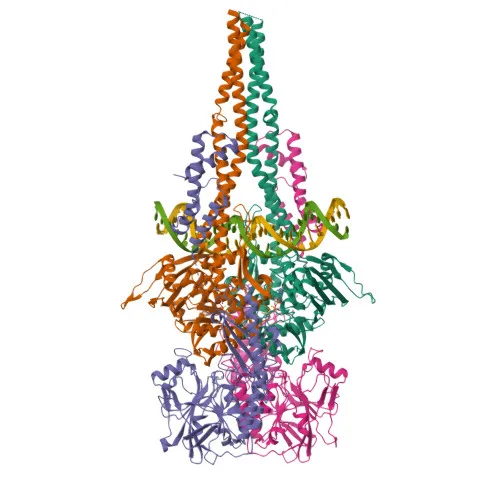
- RAD50 (DNA repair protein RAD50), also known as NBSLD or hRad50, is a core component of the MRN complex (MRE11-RAD50-NBN) that orchestrates cellular responses to DNA double-strand breaks.
- The MRN complex is essential for double-strand break repair via homologous recombination, where it mediates DNA end resection to generate single-stranded DNA necessary for strand invasion.
Related references:
PMID:15064416
PMID:21757780
PMID:27889449 - RAD50 binds and tethers DNA ends, and its ATP-dependent structural switching controls MRE11 nuclease activity, positioning DNA substrates for cleavage.
Related references:
PMID:11741547
PMID:12805565
PMID:28134932 - Beyond end resection, the MRN complex activates ATM and ATR kinases to transduce DNA damage signals, a function independent of MRE11 nuclease activity.
Related references:
PMID:15064416
PMID:15790808
PMID:16622404 - At telomeres, the MRN complex modulates t-loop formation, contributing to telomere integrity and length regulation.
Related references:
PMID:10888888 - RAD50 is also implicated in the processing of R-loops, resolving transcription-replication conflicts to maintain genomic stability.
Related references:
PMID:31537797 - Subcellularly, RAD50 localizes primarily to the nucleus, associating with chromatin and telomeres.
- Post-translational modifications include acetylation and phosphorylation, which may regulate its activity and interactions in response to DNA damage.
- Tissue expression is generally low, with notable enrichment in testis and detectable levels in fibroblasts.
Experimental Guidance and Technical Tips
- The immunogen corresponds to a C-terminal peptide (aa 1200-1300) outside the conserved ATPase and coiled-coil domains; consider verifying specificity via knockdown or knockout controls in relevant sample types.
- For Western blot, RAD50 runs at approximately 154 kDa; use a suitable gel percentage (e.g., 6% resolving gel) and ensure efficient transfer of this large protein (e.g., extended wet transfer times).
- The antibody is reported to react with human, mouse, and rat RAD50; cross-reactivity with endogenous protein in these species should be validated under your experimental conditions.
- In ELISA applications, optimal coating conditions and detection ranges should be determined empirically using the peptide immunogen or full-length recombinant protein as a standard.
CamelBio: Your One-Stop Sourcing Bridge
CamelBio partners with diagnostic manufacturers and research institutes to supply high-quality IVD raw materials like this anti-RAD50 monoclonal antibody, supporting DNA damage and repair research. Beyond antibodies, we offer validated antibody pairs, recombinant antigens, and bulk ancillary reagents to streamline assay development. Our integrated sourcing network can also assist in procuring rare-target raw materials for your specific diagnostic or research needs.
REQUEST A QUOTE
Our professional team will reply to you within one business day. Please feel free to contact us!