Polyclonal Antibodies
Anti-POLD3 Polyclonal Antibody for WB, IHC-P, IF/ICC, ELISA - Q15054
Item Number : CM0026845
Price varies based on specs and customizations
- Application
- WB, IHC-P, IF/ICC, ELISA
- Cross Reactivity
- Human, Mouse
- Protein Weight
- 51kDa

Shipping:
Contact us to get shipping details Enjoy On-time Dispatch Guarantee.
Why Choose Us
Easy ordering process, quality products, and dedicated support for your business success.
Core Product Specifications and Parameters
| Parameter | Value |
|---|---|
| Product Name | POLD3 Rabbit pAb |
| Remarks/Alias | P66; P68; PPP1R128; POLD3 |
| Species | Human |
| GeneID (Human) | 10714 |
| GeneID | 10714 |
| Immunogen | Recombinant fusion protein containing a sequence corresponding to amino acids 197-466 of human POLD3 (NP_006582.1). |
| Source | Rabbit |
| Category | Polyclonal Antibodies |
| Application | WB, IHC-P, IF/ICC, ELISA |
| Cross Reactivity | Human, Mouse |
| SWISS | Q15054 |
| Protein Weight | 51kDa |
| Shipping | Ice bag |
Biological Background: DNA polymerase delta subunit 3 Function and Localization
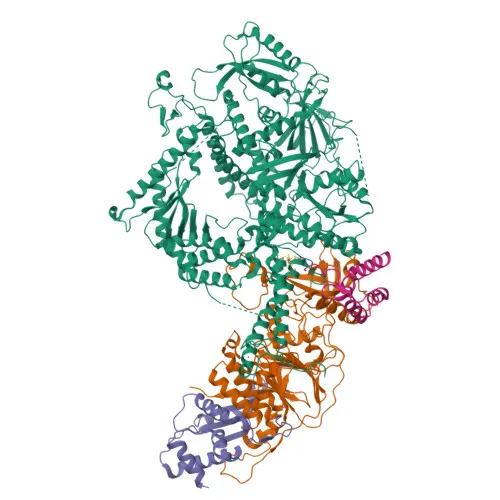
- POLD3, also known as DNA polymerase delta subunit 3 (p66/p68), is an accessory component of the DNA polymerase delta and zeta complexes.
- It plays an essential role in high-fidelity genome replication, including lagging strand synthesis, by stabilizing the Pol-delta complex and mediating stimulation by PCNA. Related references: PMID:10219083, PMID:10852724, PMID:11595739
- In the Pol-delta3 complex (lacking POLD4), POLD3 confers higher proofreading activity and is better suited for Okazaki fragment maturation due to near-absence of strand displacement. Related references: PMID:19074196, PMID:20334433, PMID:24035200
- Required for nucleotide excision repair (NER) following UV irradiation, where it assists in recruiting the catalytic subunit POLD1 to DNA damage sites. Related references: PMID:20227374
- Under replication stress, POLD3 mediates break-induced replication (BIR) to repair broken replication forks. Related references: PMID:24310611
- Involved in translesion synthesis (TLS) by facilitating bypass of abasic sites and O6-methylguanine lesions, and as part of the DNA polymerase zeta complex, it dramatically enhances processivity. Related references: PMID:19074196, PMID:25628356, PMID:27185888, PMID:24449906
- It localizes to both the cytoplasm and nucleus, and is subject to post-translational modifications including acetylation, phosphorylation, and ubiquitination.
Experimental Guidance and Technical Tips
- The immunogen used to generate this antibody spans amino acids 197–466 of human POLD3; consider that it may detect splice isoforms or processed forms lacking this region.
- For Western blot (WB), a band around 51 kDa is expected; validate in your specific sample system and use appropriate loading controls.
- In IHC-P and IF/ICC, optimal results may require antigen retrieval and fixation condition optimization; testing a range of antibody dilutions is recommended.
- ELISA detection should be validated with the appropriate coated antigen or cell lysate.
CamelBio: Your One-Stop Sourcing Bridge
CamelBio provides diagnostic manufacturers and research labs with a one-stop supply channel for IVD raw materials, covering the DNA replication and repair research area. Our portfolio includes validated antibody pairs, optimized monoclonal/polyclonal antibodies, bulk ancillary reagents, and rare-target sourcing, helping you secure consistent, high-quality materials for assay development and production.
REQUEST A QUOTE
Our professional team will reply to you within one business day. Please feel free to contact us!