Polyclonal Antibodies
Anti-ORC6 Polyclonal Antibody (Rabbit) for WB, IHC-P, ELISA - Q9Y5N6
Item Number : CM0029267
Price varies based on specs and customizations
- Application
- WB, IHC-P, ELISA
- Cross Reactivity
- Human, Mouse, Rat
- Protein Weight
- 28kDa

Shipping:
Contact us to get shipping details Enjoy On-time Dispatch Guarantee.
Why Choose Us
Easy ordering process, quality products, and dedicated support for your business success.
Core Product Specifications and Parameters
| Parameter | Value |
|---|---|
| Product Name | ORC6 Rabbit pAb |
| Remarks/Alias | ORC6L; ORC6 |
| Species | Human |
| GeneID (human) | 23594 |
| GeneID | 23594 |
| Immunogen | Recombinant fusion protein containing a sequence corresponding to amino acids 1-252 of human ORC6 (NP_055136.1). |
| Source | Rabbit |
| Category | Polyclonal Antibodies |
| Application | WB, IHC-P, ELISA |
| Cross Reactivity | Human, Mouse, Rat |
| SWISS | Q9Y5N6 |
| Protein Weight | 28kDa |
| Shipping | Ice bag |
Biological Background: ORC6 Function and Localization
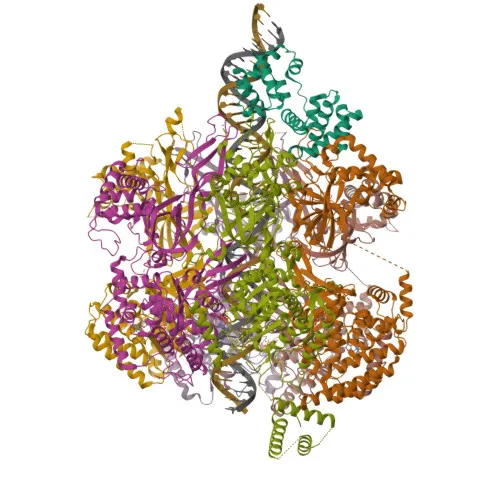
- Origin recognition complex subunit 6 (ORC6) is a core component of the origin recognition complex (ORC), which binds to DNA replication origins in an ATP-dependent manner and is essential for assembling the pre-replication complex.
- ORC6 directly binds DNA but does not interact with histone H3 or H4 trimethylation marks (H3K9me3, H3K27me3, H4K20me3), indicating a specific chromatin context for origin recognition.
- As a key initiator of DNA replication, ORC6 ensures proper cell cycle progression and genomic stability; its functional loss disrupts replication licensing.
- The protein localizes exclusively to the nucleus, consistent with its role at chromosomal replication origins.
- Post-translational modifications include phosphorylation and ubiquitin-like (Ubl) conjugation, which may regulate ORC6 stability and activity during the cell cycle.
- Disease-associated keywords such as "Dwarfism" suggest that ORC6 mutations can lead to developmental disorders, potentially through impaired DNA replication.
Experimental Guidance and Technical Tips
- The immunogen spans full‑length human ORC6 (amino acids 1–252); the resulting polyclonal antibody recognizes multiple epitopes, potentially increasing sensitivity in denaturing applications like Western blot.
- For Western blot, expect a band near 28 kDa; validate expression in replicating cell lines (e.g., HeLa) and optimize loading controls.
- In immunohistochemistry (IHC‑P), ORC6 shows nuclear staining; test antigen retrieval methods and antibody dilutions to achieve clear signal.
- Since this antibody cross‑reacts with mouse and rat ORC6, it is suitable for comparative studies across these species; verify specificity in the target tissue.
- ELISA can be used for quantitative ORC6 detection; consider pairing with a monoclonal capture antibody if a sandwich assay is required.
CamelBio: Your One-Stop Sourcing Bridge
CamelBio serves as a comprehensive one‑stop sourcing partner for IVD raw materials, spanning validated antibody pairs, optimized polyclonal antibodies like this ORC6 reagent, and bulk ancillary reagents for DNA replication and cell cycle research. Our unique position allows us to procure even rare‑target raw materials, complemented by technical consultation to streamline your diagnostic development. Leverage CamelBio’s end‑to‑end supply chain to accelerate your project from concept to clinic.
REQUEST A QUOTE
Our professional team will reply to you within one business day. Please feel free to contact us!