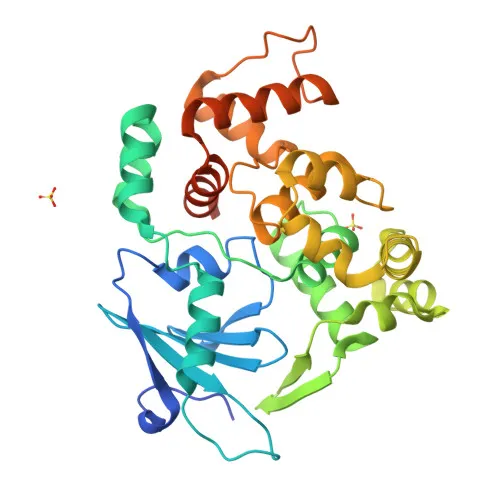
Monoclonal Antibodies
Anti-OGG1 Rabbit Monoclonal Antibody for WB, IHC-P, ELISA - O15527
Item Number : CM0008061
Price varies based on specs and customizations
- Application
- WB, IHC-P, ELISA
- Cross Reactivity
- Human, Rat
- Protein Weight
- 39 kDa

Shipping:
Contact us to get shipping details Enjoy On-time Dispatch Guarantee.
Why Choose Us
Easy ordering process, quality products, and dedicated support for your business success.
Core Product Specifications and Parameters
| Parameter | Value |
|---|---|
| Product Name | OGG1 Rabbit mAb |
| Remarks/Alias | HMMH; MUTM; OGH1; HOGG1; OGG1 |
| Species | Human |
| GeneID (Human) | 4968 |
| GeneID | 4968 |
| Immunogen | A synthetic peptide corresponding to a sequence within amino acids 246-345 of human OGG1 (O15527). |
| Source | Rabbit |
| Category | Monoclonal Antibodies |
| Application | WB, IHC-P, ELISA |
| Cross Reactivity | Human, Rat |
| SWISS | O15527 |
| Protein Weight | 39 kDa |
| Shipping | Ice bag |
Biological Background: OGG1 Function and Localization
- OGG1 (N-glycosylase/DNA lyase) is a dual-activity DNA repair enzyme that removes 8-oxoguanine (8-oxoG) and 2,6-diamino-4-hydroxy-5-N-methylformamidopyrimidine (FAPY) lesions caused by reactive oxygen species.
- The enzyme catalyzes the excision of damaged bases via its glycosylase activity, followed by a beta-lyase reaction that cleaves the DNA backbone 3' to the abasic site.
- Encoded by the OGG1 gene (also known as MMH, MUTM, OGH1), multiple isoforms are produced through alternative splicing.
- OGG1 localizes predominantly to the nucleus (including nucleoplasm, speckles, and matrix) but is also found in mitochondria, reflecting its role in both nuclear and mitochondrial genome maintenance.
- It is ubiquitously expressed across human tissues, consistent with its fundamental role in guarding against oxidative DNA damage.
- As a multifunctional enzyme, OGG1 belongs to the DNA glycosylase/AP lyase family and is essential for the base excision repair (BER) pathway.
Experimental Guidance and Technical Tips
- The immunogen corresponds to a region within amino acids 246–345 of human OGG1. Based on sequence homology, the antibody may react with multiple spliced isoforms; confirm the expected band size (predicted ~39 kDa) in your target species using Western blot.
- For WB, we recommend testing the antibody at standard dilutions (e.g., 1:500–1:2000) with appropriate loading controls, using lysates from human or rat cell lines as positive material.
- In IHC-P, optimize antigen retrieval methods (heat-induced epitope retrieval, pH 6 or 9) and ensure thorough nuclear permeabilization. Include isotype controls and absorption controls with the peptide immunogen to verify specificity.
- For ELISA, the antibody can serve as a detection or capture reagent; pairing with another OGG1 antibody (e.g., polyclonal) may improve sensitivity. Perform checkerboard titrations to determine optimal concentrations.
- As OGG1 is a low-abundance protein in some tissues, consider enriching nuclear or mitochondrial fractions prior to analysis.
CamelBio: Your One-Stop Sourcing Bridge
CamelBio supports diagnostic manufacturers and research laboratories with reliable procurement of IVD raw materials, including this anti-OGG1 monoclonal antibody for DNA damage and repair studies. We offer validated antibody pairs, optimized bulk reagents, and rare target sourcing to streamline your assay development. Contact us to leverage our one-stop supply chain from concept to clinic.
REQUEST A QUOTE
Our professional team will reply to you within one business day. Please feel free to contact us!