Monoclonal Antibodies
Anti-Human TrkA Monoclonal Antibody () for Flow Cytometry - P04629
Item Number : CM0008589
Price varies based on specs and customizations
- Application
- FC
- Cross Reactivity
- Human

Shipping:
Contact us to get shipping details Enjoy On-time Dispatch Guarantee.
Why Choose Us
Easy ordering process, quality products, and dedicated support for your business success.
Core Product Specifications and Parameters
| Parameter | Specification |
|---|---|
| Product Name | Rabbit anti-Human TrkA mAb |
| Remarks/Alias | NTRK1; MTC; TRK; TRK1; TRKA; Trk-A; p140-TrkA; neurotrophic receptor tyrosine kinase 1 |
| Species | Human |
| GeneID | 4914 |
| Immunogen | Recombinant fusion protein containing a sequence corresponding to amino acids 33-407 of human TrkA (NP_002520.2) |
| Source | Rabbit |
| Category | Monoclonal Antibodies |
| Application | FC |
| Cross Reactivity | Human |
| SWISS | P04629 |
| Protein Weight | 77kDa/83kDa/86kDa/87kDa |
| Shipping | Ice bag |
Biological Background: TrkA/NTRK1 Function and Localization
- TrkA (high affinity nerve growth factor receptor) is a receptor tyrosine kinase that binds NGF as its primary ligand, undergoing homodimerization and autophosphorylation upon ligand binding, initiating downstream signaling cascades. Related references: PMID:1281417
- The receptor is crucial for the development, maturation, and survival of sympathetic and sensory neurons by regulating proliferation, differentiation, and apoptosis through distinct signaling pathways.
- Upon activation, TrkA recruits and phosphorylates adaptor proteins such as SHC1, FRS2, SH2B1, SH2B2, and PLCG1, leading to activation of the Ras-MAPK, PI3K-AKT, and NF-κB pathways that control cell survival and differentiation. Related references: PMID:15488758, PMID:17196528
- Alternative splicing produces three isoforms: TrkA-I (widely expressed in non-neuronal tissues), TrkA-II (primarily in neuronal cells), and TrkA-III (specific to neural stem and neural crest progenitors), which exhibits oncogenic activity when overexpressed.
- TrkA localizes mainly to the cell membrane and cycles through early, late, and recycling endosomes, consistent with its role in receptor trafficking and signal modulation.
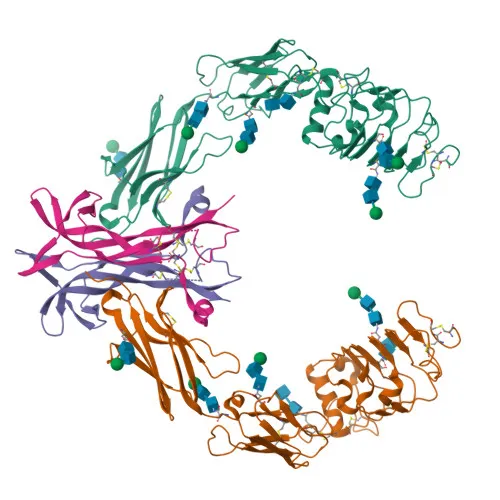
- The receptor contains characteristic structural motifs including immunoglobulin-like domains, leucine-rich repeats, and a tyrosine kinase domain, and is subject to post-translational modifications such as phosphorylation and ubiquitination.
Experimental Guidance and Technical Tips
- The immunogen corresponds to the extracellular domain (amino acids 33–407) of human TrkA, suggesting the antibody likely recognizes an epitope in the ligand-binding region, potentially suitable for detecting both membrane-bound and internalized receptor populations.
- For flow cytometry (FC), it is recommended to titrate the antibody to determine the optimal working concentration for your specific cell type and experimental conditions.
- Consider using appropriate positive and negative control cell lines (e.g., TrkA-expressing neuronal or cancer cell lines) to validate staining specificity.
- If detecting total receptor levels (surface plus intracellular), include a permeabilization step; for surface-only detection, use a non-permeabilizing protocol.
CamelBio: Your One-Stop Sourcing Bridge
CamelBio offers comprehensive one-stop access to IVD raw materials, supporting diagnostic, research, and pharmaceutical partners from early discovery through clinical application. This TrkA antibody serves neurobiology and oncology research areas, where reliable detection of NTRK1 expression is critical. Beyond this product, CamelBio can source validated antibody pairs, optimized recombinant proteins, ancillary reagents, and rare target raw materials to streamline your assay development and manufacturing workflows.
REQUEST A QUOTE
Our professional team will reply to you within one business day. Please feel free to contact us!