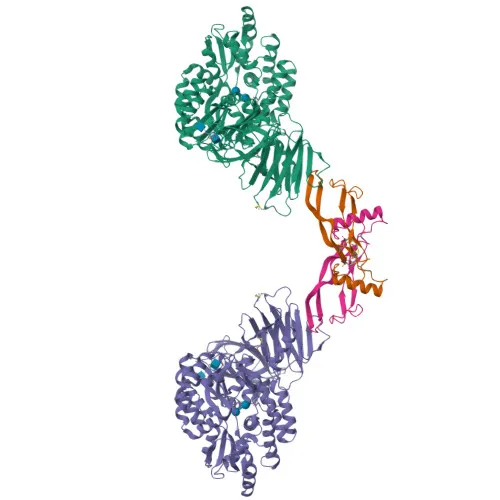
Monoclonal Antibodies
Anti-Human CD105/Endoglin Monoclonal Antibody for Flow Cytometry - P17813
Item Number : CM0009725
Price varies based on specs and customizations
- Application
- FC
- Cross Reactivity
- Human
- Protein Weight
- 67kDa/70kDa

Shipping:
Contact us to get shipping details Enjoy On-time Dispatch Guarantee.
Why Choose Us
Easy ordering process, quality products, and dedicated support for your business success.
Core Product Specifications and Parameters
| Parameter | Value |
|---|---|
| Product Name | Rabbit anti-Human CD105/Endoglin mAb |
| Remarks/Alias | ENG; END; HHT1; ORW1; endoglin |
| Species | human |
| GeneID (human) | 2022 |
| GeneID | 2022 |
| Immunogen | Recombinant fusion protein containing a sequence corresponding to amino acids 26-337 of human CD105/Endoglin (NP_001108225.1) |
| Source | Rabbit |
| Category | Monoclonal Antibodies |
| Application | FC |
| Cross Reactivity | Human |
| SWISS | P17813 |
| Protein Weight | 67kDa/70kDa |
| Shipping | Ice bag |
Biological Background: CD105/Endoglin Function and Localization
- Endoglin (CD105/ENG) is a vascular endothelium glycoprotein with multiple isoforms generated by alternative splicing; it is essential for angiogenesis regulation and maintenance of adult vascular structure and integrity (PubMed:21737454, PubMed:23300529, PubMed:7894484). Related references: PMID:21737454, PMID:23300529, PMID:7894484
- The protein promotes endothelial cell migration and facilitates cell adhesion through integrin binding, potentially via RGD receptors (PubMed:17540773, PubMed:1692830). Related references: PMID:17540773, PMID:1692830
- Functions as a TGF-beta coreceptor, mediating SMAD1 and SMAD3 signaling downstream of BMP9/GDF2 and TGFB1, respectively; this activity is critical for embryonic angiogenesis and heart development (PubMed:21737454, PubMed:22347366, PubMed:23300529). Related references: PMID:21737454, PMID:22347366, PMID:23300529
- Subcellularly, endoglin is a transmembrane protein localized to the cell membrane, where it interacts with multiple signaling complexes.
- Post-translationally, it is a glycosylated phosphoprotein with disulfide bonds that stabilize its extracellular domain.
- It is highly expressed on endothelial cells and in placental tissue, underscoring its role in vascular biology and angiogenesis.
- Mutations in ENG are linked to hereditary hemorrhagic telangiectasia type 1 (HHT1), reflecting its importance in vascular homeostasis.
Experimental Guidance and Technical Tips
- This -conjugated monoclonal antibody is designed for flow cytometry applications, enabling direct detection of human CD105 on live or fixed cells without secondary staining.
- The immunogen corresponds to the N-terminal extracellular domain (aa 26–337), suggesting the antibody recognizes an extracellular epitope; consider use in live-cell staining protocols.
- For optimal signal-to-noise ratio, titrate the antibody in the relevant cell system and include appropriate isotype and FMO controls.
- Cross-reactivity is confirmed with human; reactivity with other species is not established. If using non-human models, validate specificity independently.
CamelBio: Your One-Stop Sourcing Bridge
CamelBio is your strategic partner for IVD raw-material procurement, offering a comprehensive suite of antibodies, reagents, and technical services to accelerate your diagnostic development. This anti-CD105/Endoglin monoclonal antibody supports research into angiogenesis, vascular biology, and TGF-beta signaling pathways. Beyond antibody sourcing, CamelBio can assist with customized bulk orders, rare target reagent sourcing, and technical consultation for flow cytometry-based assays.
REQUEST A QUOTE
Our professional team will reply to you within one business day. Please feel free to contact us!