Polyclonal Antibodies
Anti-GRM1 Polyclonal Antibody for WB, IF/ICC, ELISA - Q13255
Item Number : CM0017533
Price varies based on specs and customizations
- Application
- WB, IF/ICC, ELISA
- Cross Reactivity
- Human, Mouse, Rat
- Protein Weight
- 132kDa

Shipping:
Contact us to get shipping details Enjoy On-time Dispatch Guarantee.
Why Choose Us
Easy ordering process, quality products, and dedicated support for your business success.
Core Product Specifications and Parameters
| Parameter | Value |
|---|---|
| Product Name | GRM1 Rabbit pAb |
| Remarks/Alias | MGLU1; SCA44; GPRC1A; MGLUR1; SCAR13; PPP1R85; GRM1 |
| Species | Human |
| Gene ID (Human) | 2911 |
| Gene ID | 2911 |
| Immunogen | Recombinant protein; Recombinant fusion protein containing a sequence corresponding to amino acids 920-1140 of human GRM1 (NP_001264993.1) |
| Source | Rabbit |
| Category | Polyclonal Antibodies |
| Application | WB, IF/ICC, ELISA |
| Cross Reactivity | Human, Mouse, Rat |
| SWISS | Q13255 |
| Protein Weight | 132kDa |
| Shipping | Ice bag |
Biological Background: GRM1 Function and Localization
- GRM1 encodes metabotropic glutamate receptor 1, a G protein-coupled receptor (GPCR) activated by glutamate, the major excitatory neurotransmitter in the central nervous system.
- Upon ligand binding, GRM1 couples to G proteins and activates a phosphatidylinositol-calcium second messenger system, playing critical roles in synaptic plasticity such as long-term potentiation (LTP) in the hippocampus and long-term depression (LTD) in the cerebellum (PubMed:24603153, PubMed:28886343, PubMed:7476890).
Related references: PMID:24603153 PMID:28886343 PMID:7476890 - In dopaminergic neurons and cerebellar Purkinje cells, GRM1 signaling via GNAQ-PLC-PKC pathway induces cation-channel activation of GRID1 and GRID2, respectively (PubMed:24357660, PubMed:27276689).
Related references: PMID:24357660 PMID:27276689 - The protein is localized to the cell membrane, specifically enriched at postsynaptic sites and dendritic projections, consistent with its role in synaptic transmission.
- GRM1 undergoes alternative splicing, generating isoforms that may exhibit distinct signaling properties. Mutations in this gene are associated with neurodevelopmental and neurodegenerative disorders, including spinocerebellar ataxia types SCA44 and SCAR13.
- The receptor is predominantly expressed in brain tissue, where it modulates neuronal excitability and synaptic strength.
- Post-translational modifications include glycosylation, phosphorylation, and disulfide bond formation, which are essential for receptor folding, membrane trafficking, and signal modulation.
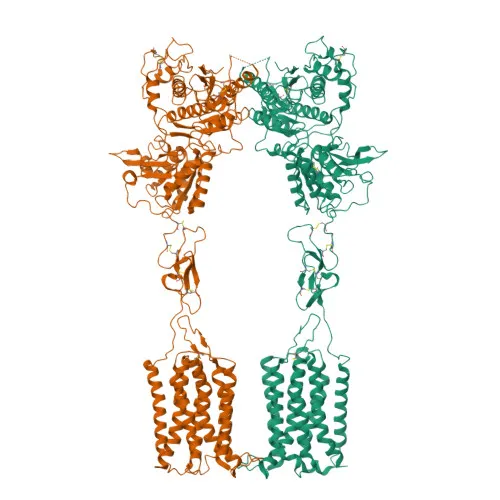
- As a Class C GPCR, GRM1 features a large extracellular N-terminal domain containing the ligand-binding venus flytrap module, connected to the 7-transmembrane core, and an intracellular C-terminal tail involved in protein interactions and signaling regulation.
Experimental Guidance and Technical Tips
- The immunogen corresponds to the intracellular C-terminal region (amino acids 920–1140) of human GRM1 (isoform NP_001264993.1). This region is distal to the transmembrane domains, making the antibody suitable for detecting total GRM1 protein levels in denaturing and native conditions.
- For Western blotting (WB), a band around 132 kDa is expected; consider using whole-cell lysates from brain tissue or neuronal cell lines (e.g., SH-SY5Y, primary neurons) and verify specificity with GRM1-overexpressing or knockout controls.
- In immunofluorescence/immunocytochemistry (IF/ICC), anticipate plasma membrane and dendritic staining patterns; co-localization with synaptic markers (e.g., PSD-95) may aid in confirming postsynaptic localization.
- When using ELISA, consider the antibody pair design and test cross-reactivity with other mGluR family members (e.g., GRM5) if needed, due to sequence conservation in the C-terminal region.
- Validate the antibody in your specific sample system, as post-translational modifications and protein complex formation may affect detection.
CamelBio: Your One-Stop Sourcing Bridge
CamelBio serves as your comprehensive partner for IVD raw-material sourcing, offering diagnostic manufacturers and neuroscience research labs streamlined access to high-quality reagents. Whether you need validated antibody pairs, optimized recombinant proteins, or bulk ancillary materials, our portfolio covers critical targets like metabotropic glutamate receptors for synaptic plasticity and CNS disorder studies. We also facilitate rare target sourcing and customized solutions, supporting your project from initial concept through clinical application.
REQUEST A QUOTE
Our professional team will reply to you within one business day. Please feel free to contact us!