Polyclonal Antibodies
Anti-GNAI3 Rabbit Polyclonal Antibody for WB and ELISA - P08754
Item Number : CM0014935
Price varies based on specs and customizations
- Application
- WB, ELISA
- Cross Reactivity
- Human, Mouse, Rat
- Protein Weight
- 41 kDa

Shipping:
Contact us to get shipping details Enjoy On-time Dispatch Guarantee.
Why Choose Us
Easy ordering process, quality products, and dedicated support for your business success.
Core Product Specifications and Parameters
| Parameter | Value |
|---|---|
| Product Name | GNAI3 Rabbit pAb |
| Remarks/Alias | 87U6, HG1A, ARCND1, ARCODS, GNAI3 |
| Species | Human |
| Gene ID | 2773 |
| Immunogen | Synthetic peptide corresponding to a sequence within amino acids 1-100 of human GNAI3 (NP_006487.1) |
| Source | Rabbit |
| Category | Polyclonal Antibodies |
| Application | WB, ELISA |
| Cross Reactivity | Human, Mouse, Rat |
| SWISS | P08754 |
| Protein Weight | 41 kDa |
| Shipping | Ice bag |
Biological Background: GNAI3 Function and Localization
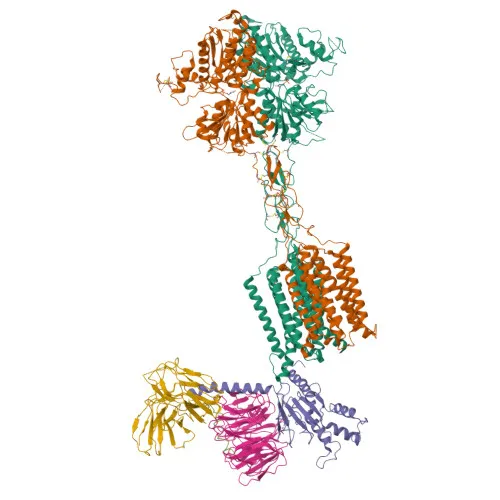
- GNAI3 encodes the G(i) alpha-3 subunit, a heterotrimeric G protein that transduces signals from GPCRs by cycling between inactive GDP-bound and active GTP-bound states; its intrinsic GTPase activity terminates signaling. GDP release and GTP hydrolysis are tightly regulated by accessory proteins. Related references: PMID:18434541 PMID:19478087 PMID:8774883
- Activated GNAI3 inhibits adenylate cyclase, reducing intracellular cAMP levels. Related references: PMID:19478087
- GNAI3 stimulates receptor-regulated K+ channels, influencing membrane potential. Related references: PMID:2535845
- The active, GTP-bound form prevents RGS14 association with centrosomes and promotes its cytoplasmic-to-membrane translocation, suggesting a role in cell division. Related references: PMID:17635935
- GNAI3 activates the calcium-permeant TRPC5 ion channels in a GTP-dependent manner. Related references: PMID:37137991
- Subcellularly, GNAI3 localizes to the cytoplasm, cell membrane, and centrosomes, with dynamic re-localization depending on activation state. It undergoes myristoylation and palmitoylation and is a substrate for ADP-ribosylation.
- Mutations in GNAI3 are associated with auriculocondylar syndrome (ARCND1, ARCODS), a rare craniofacial disorder.
Experimental Guidance and Technical Tips
- The immunogen targets the N-terminal region (aa 1-100) of human GNAI3, which contains the myristoylation motif and is critical for membrane interaction. Consider potential epitope masking in native complexes.
- For Western blotting, expect a major band near 41 kDa. Validate in samples from human, mouse, or rat based on the stated reactivity.
- In ELISA, optimize antibody dilution and assay conditions for your specific application (capture or detection).
- Because of high homology within the Gαi subfamily, cross-reactivity with GNAI1 or GNAI2 is possible; verify specificity in your experimental system if needed.
CamelBio: Your One-Stop Sourcing Bridge
CamelBio connects diagnostic manufacturers and research institutes with reliable IVD raw materials, including the GNAI3-targeted reagents described here. We provide validated antibody pairs, optimized monoclonal and polyclonal antibodies, bulk ancillary reagents, and custom sourcing for rare or challenging targets. Explore our portfolio to accelerate your assay development from concept to clinic.
REQUEST A QUOTE
Our professional team will reply to you within one business day. Please feel free to contact us!