Polyclonal Antibodies
Anti-DLL4 Rabbit Polyclonal Antibody for WB and ELISA - Q9NR61
Item Number : CM0013376
Price varies based on specs and customizations
- Application
- WB, ELISA
- Cross Reactivity
- Human, Mouse, Rat
- Protein Weight
- 75kDa

Shipping:
Contact us to get shipping details Enjoy On-time Dispatch Guarantee.
Why Choose Us
Easy ordering process, quality products, and dedicated support for your business success.
Core Product Specifications and Parameters
| Parameter | Value |
|---|---|
| Product Name | DLL4 Rabbit pAb |
| Remarks/Alias | AOS6; delta4; hdelta2; DLL4 |
| Species | Human |
| GeneID (Human) | 54567 |
| GeneID | 54567 |
| Immunogen | Recombinant fusion protein containing a sequence corresponding to amino acids 317-530 of human DLL4 (NP_061947.1). |
| Source | Rabbit |
| Category | Polyclonal Antibodies |
| Application | WB, ELISA |
| Cross Reactivity | Human, Mouse, Rat |
| SWISS | Q9NR61 |
| Protein Weight | 75kDa |
| Shipping | Ice bag |
Biological Background: DLL4 Function and Localization
- Delta-like protein 4 (DLL4), also known as Drosophila Delta homolog 4, is a transmembrane ligand in the Notch signaling pathway that activates NOTCH1 and NOTCH4 receptors to regulate cell fate decisions. Related references: PMID:11134954
- DLL4 plays a critical role in angiogenesis by negatively regulating endothelial cell proliferation, migration, and angiogenic sprouting. Related references: PMID:20616313
- The protein is essential for retinal progenitor cell proliferation and proper generation of retinal cell types, including suppression of rod fates in late progenitors (By similarity).
- During spinal cord neurogenesis, DLL4 inhibits V2a interneuron fate specification. Related references: PMID:17728344
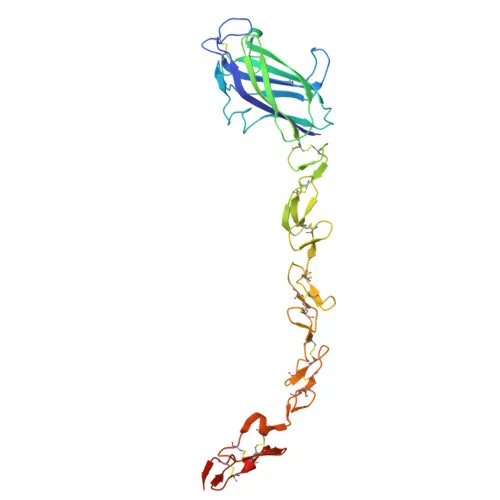
- DLL4 is a single-pass type I membrane protein localized at the cell membrane, featuring an extracellular region with multiple EGF-like domains, disulfide bonds, and glycosylation sites characteristic of Notch ligands.
- It is predominantly expressed in vascular endothelium, consistent with its key role in vascular development and angiogenesis.
- Post-translational modifications, including glycosylation and proteolytic processing, are critical for DLL4 function as a signaling ligand.
Experimental Guidance and Technical Tips
- For Western blotting, expect a band at ~75 kDa. Use positive controls such as HUVEC or other vascular endothelial cell lysates known to express DLL4.
- The immunogen covers amino acids 317–530 of the extracellular domain; ensure thorough protein extraction and denaturation for membrane protein detection.
- Validate cross-reactivity in mouse or rat samples by aligning the epitope region to confirm sequence conservation; adjust sample preparation as needed.
- For ELISA, optimize coating antigen concentration and use cell lysates or recombinant DLL4 as standards; consider testing multiple detection conditions for best signal-to-noise ratio.
- Include appropriate negative controls (e.g., DLL4-deficient lysates) to confirm antibody specificity in your experimental system.
CamelBio: Your One-Stop Sourcing Bridge
CamelBio provides diagnostic manufacturers, labs, and research institutes with one-stop access to IVD raw materials, technical services, and consulting—covering every stage from concept to clinic. This anti-DLL4 antibody supports angiogenesis, Notch signaling, and developmental biology research, a key focus area for our customers. We offer validated antibody pairs, optimized monoclonal and polyclonal antibodies, bulk ancillary reagents, and assist with sourcing rare-target raw materials to streamline your assay development.
REQUEST A QUOTE
Our professional team will reply to you within one business day. Please feel free to contact us!