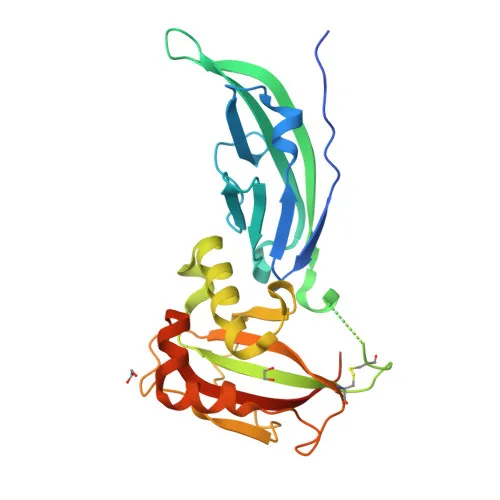
Polyclonal Antibodies
Anti-DAG1 Polyclonal Antibody for WB, IF/ICC, IP, ELISA - Q14118
Item Number : CM0016072
Price varies based on specs and customizations
- Application
- WB, IF/ICC, IP, ELISA
- Cross Reactivity
- Human, Mouse, Rat
- Protein Weight
- 97kDa

Shipping:
Contact us to get shipping details Enjoy On-time Dispatch Guarantee.
Why Choose Us
Easy ordering process, quality products, and dedicated support for your business success.
Core Product Specifications and Parameters
| Parameter | Value |
|---|---|
| Product Name | DAG1 Rabbit pAb |
| Remarks/Alias | A3a; DAG; AGRNR; 156DAG; MDDGA9; MDDGC7; MDDGC9; LGMDR16; DAG1 |
| Species | Human |
| Gene ID | 1605 |
| Immunogen | Recombinant fusion protein containing a sequence corresponding to amino acids 776-895 of human DAG1 (NP_001171108.1) |
| Source | Rabbit |
| Category | Polyclonal Antibodies |
| Application | WB, IF/ICC, IP, ELISA |
| Cross Reactivity | Human, Mouse, Rat |
| SWISS | Q14118 |
| Protein Weight | 97kDa |
| Shipping | Ice bag |
Biological Background: DAG1 Function and Localization
- DAG1 is cleaved into alpha and beta dystroglycan; alpha-dystroglycan is a heavily glycosylated extracellular receptor, while beta-dystroglycan is a transmembrane protein linking to the cytoskeleton.
- Alpha-dystroglycan binds laminins, agrin, perlecan, and pikachurin, mediating basement membrane assembly, cell adhesion, and signaling through pathways such as PI3K/AKT and Src/Rac1/JNK.
- Beta-dystroglycan anchors the dystrophin-glycoprotein complex to dystrophin or utrophin, connecting the extracellular matrix to the actin cytoskeleton.
- At the neuromuscular junction, it clusters acetylcholine receptors and anchors acetylcholinesterase via perlecan binding.
- In cartilage, agrin binding upregulates SOX9, a key transcription factor for chondrocyte differentiation. Related references: PMID:26290588
- Serves as a receptor for Lassa virus, lymphocytic choriomeningitis virus, and other class C arenaviruses. Related references: PMID:16254364, PMID:17360738, PMID:19324387
- Mediates Schwann cell adhesion and internalization of Mycobacterium leprae. Related references: PMID:9851927
- Localizes to the extracellular matrix, basement membrane, sarcolemma, synapse, cytoplasm, and nucleus; expressed in a variety of fetal and adult tissues, including keratinocytes and fibroblasts.
Experimental Guidance and Technical Tips
- The immunogen corresponds to the C-terminal region (aa 776–895) of human DAG1, likely yielding reactivity with both alpha- and beta-dystroglycan isoforms. Consider verifying reactivity in your species and tissue of interest.
- For Western blot, the intact precursor is ~97 kDa, but alpha-dystroglycan often appears as a broad band due to extensive glycosylation. A ~43 kDa beta-dystroglycan band may also be detected.
- In IF/ICC and IP, validate fixation/permeabilization and antibody concentration, as epitope accessibility may be influenced by glycosylation and subcellular localization.
- ELISA is suitable for detecting recombinant DAG1 or native protein in lysates; include appropriate controls to confirm specificity.
CamelBio: Your One-Stop Sourcing Bridge
CamelBio connects diagnostic manufacturers and research laboratories with a comprehensive portfolio of IVD raw materials, including validated antibodies, antigen pairs, and ancillary reagents. For dystroglycan and extracellular matrix research, we offer a reliable supply of polyclonal and monoclonal antibodies, bulk production support, and custom sourcing for rare targets. Let CamelBio accelerate your assay development from concept to clinic.
REQUEST A QUOTE
Our professional team will reply to you within one business day. Please feel free to contact us!