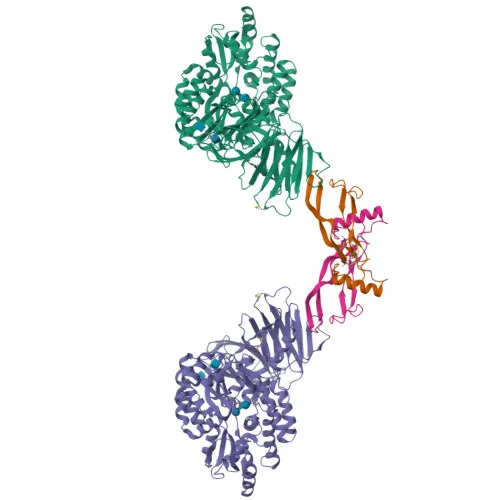
Polyclonal Antibodies
Anti-CD105/Endoglin Rabbit Polyclonal Antibody for WB and ELISA - P17813
Item Number : CM0029082
Price varies based on specs and customizations
- Application
- WB, ELISA
- Cross Reactivity
- Human, Mouse
- Protein Weight
- 71kDa

Shipping:
Contact us to get shipping details Enjoy On-time Dispatch Guarantee.
Why Choose Us
Easy ordering process, quality products, and dedicated support for your business success.
Core Product Specifications and Parameters
| Parameter | Value |
|---|---|
| Product Name | CD105/Endoglin Rabbit pAb |
| Remarks/Alias | END; HHT1; ORW1; CD105/Endoglin |
| Species | Human |
| Gene ID (Human) | 2022 |
| Gene ID | 2022 |
| Immunogen | Recombinant fusion protein containing a sequence corresponding to amino acids 26-337 of human CD105/Endoglin (NP_001108225.1) |
| Source | Rabbit |
| Category | Polyclonal Antibodies |
| Application | WB, ELISA |
| Cross Reactivity | Human, Mouse |
| SWISS | P17813 |
| Protein Weight | 71kDa |
| Shipping | Ice bag |
Biological Background: Endoglin Function and Localization
- Endoglin is a transmembrane glycoprotein and member of the zona pellucida (ZP) domain-containing protein family, encoded by the ENG gene; alternative splicing produces multiple isoforms.
- Endoglin is a key regulator of angiogenesis, required for endothelial cell migration and normal vascular structure and integrity. Related references: PMID:21737454, PMID:23300529, PMID:17540773, PMID:7894484
- Endoglin serves as a TGF-beta superfamily co-receptor, modulating both BMP9 and TGF-beta1 signaling to activate SMAD1 and SMAD3 transcription factors. Related references: PMID:21737454, PMID:22347366, PMID:23300529
- It is localized to the cell membrane and mediates endothelial cell adhesion by binding integrins and RGD-containing proteins. Related references: PMID:1692830
- Post-translational modifications include disulfide bonds, N-linked glycosylation, and phosphorylation, which may regulate its function.
- Endoglin is highly expressed in vascular endothelial cells and placenta. Related references: PMID:10625079, PMID:1692830
- Mutations in ENG cause hereditary hemorrhagic telangiectasia type 1 (HHT1/ORW1), underscoring its vascular importance.
Experimental Guidance and Technical Tips
- The immunogen corresponds to the N-terminal extracellular domain (aa 26-337), which is predicted to be exposed on the cell surface; this design may enhance recognition of native Endoglin in ELISA and denatured forms in WB.
- For WB, the predicted molecular weight is approximately 71 kDa; glycosylated forms may migrate slightly higher.
- Cross-reactivity with mouse is reported; consider performing sequence alignment to assess suitability for other species.
- As a polyclonal antibody, it may exhibit lot-to-lot variability; validate performance in your specific sample system.
CamelBio: Your One-Stop Sourcing Bridge
CamelBio supports your vascular biology and angiogenesis research with this anti-Endoglin antibody and a comprehensive range of IVD raw-material solutions. Our portfolio includes validated antibody pairs, optimized polyclonal antibodies, bulk ancillary reagents, and rare target sourcing—helping diagnostic manufacturers and labs streamline development from concept to clinic.
Product Datasheet
Anti-CD105/Endoglin Rabbit Polyclonal Antibody for WB and ELISA - P17813
REQUEST A QUOTE
Our professional team will reply to you within one business day. Please feel free to contact us!