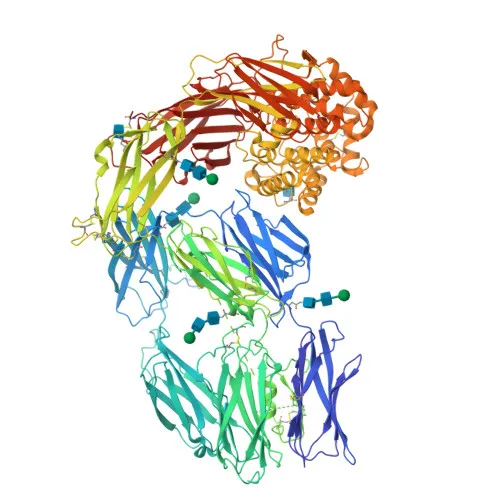
Polyclonal Antibodies
Anti-A2ML1 Rabbit Polyclonal Antibody for WB, ELISA - A8K2U0
Item Number : CM0024630
Price varies based on specs and customizations
- Application
- WB, ELISA
- Cross Reactivity
- Human, Rat
- Protein Weight
- 161kDa

Shipping:
Contact us to get shipping details Enjoy On-time Dispatch Guarantee.
Why Choose Us
Easy ordering process, quality products, and dedicated support for your business success.
Core Product Specifications and Parameters
| Parameter | Value |
|---|---|
| Product Name | A2ML1 Rabbit pAb |
| Remarks/Alias | OMS; p170; CPAMD9; A2ML1 |
| Species | Human |
| Gene ID (Human) | 144568 |
| Gene ID | 144568 |
| Immunogen | Synthetic peptide|A synthetic peptide corresponding to a sequence within amino acids 400-500 of human A2ML1 (NP_653271.3). |
| Source | Rabbit |
| Category | Polyclonal Antibodies |
| Application | WB, ELISA |
| Cross Reactivity | Human, Rat |
| SWISS | A8K2U0 |
| Protein Weight | 161kDa |
| Shipping | Ice bag |
Biological Background: Alpha-2-macroglobulin-like protein 1 Function and Localization
- A2ML1 (Alpha-2-macroglobulin-like protein 1) is a secreted protease inhibitor belonging to the alpha-2-macroglobulin family. It is also known as OMS, p170, or CPAMD9.
- It inhibits all four classes of proteinases via a unique trapping mechanism. A bait region with specific cleavage sites, when cleaved, induces a conformational change that entraps the protease. The trapped enzyme remains active against small substrates but not large ones.
- Following cleavage, a thioester bond is hydrolyzed, mediating covalent binding of A2ML1 to the protease. This mechanism involves key disulfide bonds and contributes to its inhibitory specificity.
- A2ML1 displays inhibitory activity against chymotrypsin, papain, thermolysin, and subtilisin A, and to a lesser extent elastase, but not trypsin.
- The protein may play an important role in epidermal desquamation by inhibiting extracellular proteases. It is predominantly expressed in the granular layer at the apical edge of keratinocytes, with additional expression in placenta, testis, and thymus.
- Encoded by the A2ML1 gene on chromosome 12 (locus 12p13.31), the protein undergoes alternative splicing and is detected as a 161 kDa glycoprotein.
Experimental Guidance and Technical Tips
- For Western blot analysis, consider using reducing SDS-PAGE to detect a band at approximately 161 kDa. Validate the antibody in your relevant cell or tissue lysate system.
- The immunogen (amino acids 400-500) is likely conserved between human and rat, supporting the reported cross-reactivity. Perform sequence alignment to verify epitope conservation if using this antibody in other species.
- For ELISA applications, titrate the antibody to determine optimal coating and detection concentrations against native or recombinant A2ML1. Include appropriate controls to minimize background.
- Given the protein’s role in protease inhibition, be cautious of potential interactions with endogenous proteases in sample preparations that could affect detection.
CamelBio: Your One-Stop Sourcing Bridge
CamelBio provides diagnostic manufacturers and research groups with a comprehensive portfolio of IVD raw materials, including validated polyclonal antibodies for targets like A2ML1. We supply antibody pairs, bulk ancillary reagents, and custom sourcing services for rare or challenging proteins, supporting your workflow from assay development to clinical application. Leverage our A2ML1 antibody to advance your investigations into protease inhibition mechanisms and dermatology research.
REQUEST A QUOTE
Our professional team will reply to you within one business day. Please feel free to contact us!